May 10, 2022 at 01:15PM How Politics Poisoned the Evangelical Church
“Before I turn to the Word,” the preacher announces, “I’m gonna do another diatribe.”
“Go on!” one man yells. “Amen!” shouts a woman several pews in front of me.
Between 40 minutes of praise music and 40 minutes of preaching is the strangest ritual I’ve ever witnessed inside a house of worship. Pastor Bill Bolin calls it his “diatribe.” The congregants at FloodGate Church, in Brighton, Michigan, call it something else: “Headline News.”
Explore the June 2022 Issue
Check out more from this issue and find your next story to read.
Bolin, in his mid-60s, is a gregarious man with thick jowls and a thinning wave of dyed hair. His floral shirt is untucked over dark-blue jeans. “On the vaccines …” he begins.
For the next 15 minutes, Bolin does not mention the forgiveness of sins, the resurrection of the body, or the life everlasting. Instead, he spouts misinformation and conspiratorial nonsense, much of it related to the “radically dangerous” COVID-19 vaccines. “A local nurse who attends FloodGate, who is anonymous at this time—she reported to my wife the other day that at her hospital, they have two COVID patients that are hospitalized. Two.” Bolin pauses dramatically. “They have 103 vaccine-complication patients.” The crowd gasps.
“How about this one?” Bolin says. He tells of a doctor who claims to know that “between 100 and 200 United States Congress members, plus many of their staffers and family members with COVID, were treated by a colleague of his over the past 15 months … with …” Bolin stops and puts a hand to his ear. A chorus of people responds: “Ivermectin.” Bolin pretends not to hear. “What was that?” he says, leaning over the lectern. This time, they shout: “Ivermectin!” Bolin nods.
This isn’t my first time at FloodGate, so none of what Bolin says shocks me. Yet I’m still struggling to make sense of the place.
Bolin in February. After he held indoor Easter services at FloodGate in 2020, in defiance of Michigan’s emergency shutdown orders, attendance at his church soared. (Jonno Rattman for The Atlantic)
Having grown up just down the road, the son of the senior pastor at another church in town, I’ve spent my life watching evangelicalism morph from a spiritual disposition into a political identity. It’s heartbreaking. So many people who love the Lord, who give their time and money to the poor and the mourning and the persecuted, have been reduced to a caricature. But I understand why. Evangelicals—including my own father—became compulsively political, allowing specific ethical arguments to snowball into full-blown partisan advocacy, often in ways that distracted from their mission of evangelizing for Christ. To his credit, even when my dad would lean hard into a political debate, he was careful to remind his church of the appropriate Christian perspective. “God doesn’t bite his fingernails over any of this,” he would say around election time. “Neither should you.”
Brighton is a small town, and I knew the local evangelical scene like it was a second reporting beat. I knew which pastors were feuding; whose congregations were mired in scandal; which church softball teams had a deacon playing shortstop, and which ones stacked their lineups with non-tithing ringers. But FloodGate? I had never heard of FloodGate. And neither had most of the people sitting around me, until recently.
For a decade, Bolin preached to a crowd of about 100 on a typical Sunday. Then came Easter 2020, when Bolin announced that he would hold indoor worship services in defiance of Michigan’s emergency shutdown orders. As word got around the conservative suburbs of Detroit, Bolin became a minor celebrity. Local politicians and activists borrowed his pulpit to promote right-wing interests. FloodGate’s attendance soared as members of other congregations defected to the small roadside church. By Easter 2021, FloodGate was hosting 1,500 people every weekend.
On this particular fall Sunday, Bolin riffs on everything from California forcing vaccines on schoolchildren to the IRS proposing more oversight of personal banking accounts. He promotes a new book that tells of “how the left has done a power grab to systematically dismantle religion and banish God from the lips, minds, and hearts of believers,” prompting the couple in front of me to make a one-click Amazon purchase. He suggests there is mounting evidence of a stolen election, concluding, “With the information that’s coming out in Arizona and Georgia and other places, I think it’s time for there to be a full audit of all 50 states to find out the level of cheating and the level of manipulation that actually took place.” The people around me cheer.
At one point, Bolin looks up from his notes.
“We had a visitor this morning who said, ‘You know, it’s really refreshing to hear a pastor talk about issues like this.’ ” Basking in the ovation he’s just invited, Bolin adds: “I’m okay talking about these things.”
He asks if he can keep going. The crowd answers with more applause.
Listening to Bolin that morning, I kept thinking about another pastor nearby, one who approached his job very differently: Ken Brown.
Brown leads his own ministry, Community Bible Church, in the Detroit suburb of Trenton. I got to know him during the 2020 presidential campaign, when I was writing dispatches from around the country and asking readers about the stories and trends they thought weren’t receiving enough attention. Brown wrote to me explaining the combustible dynamics within the evangelical Church and describing his own efforts—as the conservative pastor of a conservative congregation—to keep his members from being radicalized by the lies of right-wing politicians and media figures.
When we finally met, in the spring of 2021, Brown told me his alarm had only grown. “The crisis for the Church is a crisis of discernment,” he said over lunch. “Discernment”—one’s basic ability to separate truth from untruth—“is a core biblical discipline. And many Christians are not practicing it.” A stocky man with steely blue eyes and a subdued, matter-of-fact tone, Brown struck me as thoroughly disheartened. The pastor said his concern was not simply for his congregation of 300, but for the millions of American evangelicals who had come to value power over integrity, the ephemeral over the eternal, moral relativism over bright lines of right and wrong.
He made a compelling case. So I began checking out his sermons, podcasts, and blog posts.
Brown (right) in February. When COVID arrived, he launched a podcast to combat misinformation among his congregants. (Jonno Rattman for The Atlantic)
Every time I heard Bolin preach, I could also hear Brown, the pastors’ voices dueling inside my brain. Brown is polished and buttoned-down; Bolin is ostentatious and loud. Brown pastors a traditional church where people wear sweaters and sing softly; Bolin leads a charismatic church where people dress for a barbecue and speak in tongues. Brown is a pastor’s kid and lifelong conservative who’s never had a sip of alcohol; Bolin is an erstwhile “radical liberal” who once got “so high on LSD” that he jumped onstage and grabbed a guitar at a Tom Petty concert.
But in leading their predominantly white, Republican congregations, Brown and Bolin have come to agree on one important thing: Both pastors believe there is a war for the soul of the American Church—and both have decided they cannot stand on the sidelines. They aren’t alone. To many evangelicals today, the enemy is no longer secular America, but their fellow Christians, people who hold the same faith but different beliefs.
How did this happen? For generations, white evangelicals have cultivated a narrative pitting courageous, God-fearing Christians against a wicked society that wants to expunge the Almighty from public life. Having convinced so many evangelicals that the next election could trigger the nation’s demise, Christian leaders effectively turned thousands of churches into unwitting cells in a loosely organized, hazily defined, existentially urgent movement—the types of places where paranoia and falsehoods flourish and people turn on one another.
“Hands down, the biggest challenge facing the Church right now is the misinformation and disinformation coming in from the outside,” Brown said.
Because of this, the pastor told me, he can no longer justify a passive approach from the pulpit. The Church is becoming radicalized—and pastors who don’t address this fact head-on are only contributing to the problem. He understands their reluctance. They would rather keep the peace than risk alienating anyone. The irony, Brown said, is that by pretending that a clash of Christian worldviews isn’t happening, these pastors risk losing credibility with members who can see it unfolding inside their own church.
There is one person Pastor Brown doesn’t have to convince of this: Pastor Bolin.
“The battle lines have been drawn,” Bolin told me, sitting in the back of his darkened sanctuary. “If you’re not taking a side, you’re on the wrong side.”
If this is a tale of two churches, it is also the tale of churches everywhere. It’s the story of millions of American Christians who, after a lifetime spent considering their political affiliations in the context of their faith, are now considering their faith affiliations in the context of their politics.
The first piece of scripture I memorized as a child—the verse that continues to guide my own imperfect walk—is from Paul’s second letter to the early Church in Corinth, Greece. As with most of his letters, the apostle was addressing dysfunction and breakage in the community of believers. “We fix our eyes not on what is seen, but on what is unseen,” Paul wrote. “Since what is seen is temporary, but what is unseen is eternal.”
Paul’s admonishment of the early Church contains no real ambiguity. Followers of Jesus are to orient themselves toward his enduring promise of salvation, and away from the fleeting troubles of humanity.
For much of my lifetime, however, American Christians have done the opposite. Beginning in the 1980s, white evangelicals imposed themselves to an unprecedented degree on the government and the country’s core institutions. Once left to cry jeremiads about civilizational decline—having lost fights over sex and sexuality, drugs, abortion, pornography, standards in media and education, prayer in public schools—conservative Christians organized their churches, marshaled their resources, and leveraged their numbers, regaining the high ground, for a time, in some of these culture wars.
Short-lived victories, however, came at a long-term cost. Evangelical leaders set something in motion decades ago that pastors today can no longer control. Not only were Christians conditioned to understand their struggle as one against flesh and blood, fixated on earthly concerns, a fight for a kingdom of this world—all of which runs directly counter to the commands of scripture—they were indoctrinated with a belief that because the stakes were getting so high, any means was justified.
Which brings us to Donald Trump.
When Trump was elected thanks to a historic showing among white evangelicals—81 percent voted for him over Hillary Clinton—the victory was rightly viewed as the apex of the movement’s power. But this was, in many ways, also the beginning of its unraveling. The “battle lines” Bolin described as having emerged over the past five years—cultural reckonings over racism and sexual misconduct; a lethal pandemic and fierce disputes over vaccines and government mandates; allegations of election theft that led to a siege of the U.S. Capitol; and, underlying all of this, the presidency, prosecution, and martyring of Trump himself—have carved up every institution of American society. The evangelical Church is no exception.
The nation’s largest denomination, the Southern Baptist Convention, is bleeding members because of ferocious infighting over race relations, women serving in leadership, accountability for sexual misconduct, and other issues. The United Methodist Church, America’s second-largest denomination, is headed toward imminent divorce over irreconcilable social and ideological divisions. Smaller denominations are losing affiliate churches as pastors and congregations break from their leadership over many of the same cultural flash points, choosing independence over associating with those who do not hold their views.
Perhaps it shouldn’t be surprising that Christians, like Americans from every walk of life, are self-selecting into cliques of shared habits and thinking. But what’s notable about the realignment inside the white evangelical Church is its asymmetry. Pastors report losing an occasional liberal member because of their refusal to speak on Sunday mornings about bigotry or poverty or social injustice. But these same pastors report having lost—in the past few years alone—a significant portion of their congregation because of complaints that they and their staff did not advance right-wing political doctrines. Hard data are difficult to come by; churches are not required to disclose attendance figures. But a year’s worth of conversations with pastors, denominational leaders, evangelical scholars, and everyday Christians tells a clear story: Substantial numbers of evangelicals are fleeing their churches, and most of them are moving to ones further to the right.
Christianity has traditionally been seen as a stabilizing, even moderating, influence on American life. In 1975, more than two-thirds of Americans expressed “a great deal or quite a lot of confidence in the church,” according to Gallup, and as of 1985, “organized religion was the most revered institution” in American life. Today, Gallup reports, just 37 percent of Americans have confidence in the Church. This downward spiral owes principally to two phenomena: the constant stench of scandal, with megachurches and prominent leaders imploding on what seems like a weekly basis; and the growing perception that Christians are embracing extremist views. One rarely needs to read to the bottom of a poll to learn that the religious group most opposed to vaccines, most convinced that the 2020 presidential election was stolen, most inclined to subscribe to QAnon conspiracy theories is white evangelicals.
Many right-wing pastors have formed alliances—with campaign consultants, education activists, grassroots groups, even MAGA-in-miniature road shows promoting claims of an assault on American sovereignty—that bring a steady flow of fresh faces into their buildings. From there, the fusion of new Republican orthodoxy with old conservative theology is seamless. This explains why, even during a period of slumping church attendance, the number of white evangelicals has grown: The Pew Research Center reports that more and more white Trump supporters began self-identifying as evangelicals during his presidency, whether or not they attended church.
Meanwhile, other pastors feel trapped. One stray remark could split their congregation, or even cost them their job. Yet a strictly apolitical approach can be counterproductive; their unwillingness to engage only invites more scrutiny. The whisper campaigns brand conservative pastors as moderate, and moderate pastors as Marxists. In this environment, a church leader’s stance on biblical inerrancy is less important than whether he is considered “woke.” His command of scripture is less relevant than suspicions about how he voted in the last election.
“A pastor asked me the other day, ‘What percentage of churches would you say are grappling with these issues?’ And I said, ‘One hundred percent. All of them,’ ” Russell Moore, the public theologian at Christianity Today, told me. “I don’t know of a single church that’s not affected by this.”
Once the president of the Southern Baptist policy arm, Moore quit the denomination in 2021 after enduring years of “psychological warfare” for his opposition to Trumpism and advocacy for racial reconciliation. In the time since, as he’s traveled the country and counseled pastors on the intensifying divisions within their congregations, Moore has become convinced that the problem of political fanaticism inside the Church poses real threats outside it.
“Honestly, I’m more concerned than I was a year ago—and that’s saying something,” Moore said. “It may sound like Chicken Little. But I’m telling you, there is a serious effort to turn this ‘two countries’ talk into something real. There are Christians taking all the populist passions and adding a transcendent authority to it.”
Moore is not exaggerating. More than a few times, I’ve heard casual talk of civil war inside places that purport to worship the Prince of Peace. And, far from feeling misplaced, these conversations draw legitimacy from a sense of divine justice.
The Church is not a victim of America’s civic strife. Instead, it is one of the principal catalysts.
“I was a card-carrying member—literally, a card-carrying member—of the Moral Majority,” Brown told me.
It was 1981. Brown was an undergraduate at the University of Michigan, and for the first time, the Christian kid who’d graduated from a Christian high school was outside his bubble. He felt threatened by what he saw all around him: moral relativism, shameless sexuality, far-left professors who openly disparaged his faith. Brown found an identity in the nascent evangelical movement that aimed to restore the religious values of America’s founding. He read the books, watched the videos, listened to the radio programs. Brown committed himself not just to the dogma of the religious right, but to the precepts of political conservatism. For many years—while getting married, starting a career in technology, having children—he remained rooted in both.
When Brown felt called to join the clergy, he enrolled at Detroit Baptist Theological Seminary. It was there that he began to question the union of his politics and his faith. The more he studied scripture, the less confident he felt in the people he’d listened to for so long. Some of the Christian right’s leading voices—people like Paul Weyrich, of the Heritage Foundation, and James Dobson, of Focus on the Family—promoted visions of “postmillennialism,” a controversial interpretation of scripture that encourages amassing political power as a means of building a kingdom in this life parallel to that in heaven.
“I started to realize that a lot of these religious-right guys weren’t actually trained theologians. A lot of them didn’t know what they were talking about, biblically,” Brown said. “I worried that could come back to haunt us.”
Just when Brown’s passion for politics was beginning to abate, Bill Clinton was elected president. “The apocalypse,” Brown recalled, laughing. Like so many evangelicals, the pastor viewed Clinton as the manifestation of America’s moral decline. He obsessed over the president’s every scandal and deception.
But Brown was growing equally disillusioned with Christian conservatives and their tactics. Some of the same people who tormented Clinton and lectured on morality were just as ethically compromised as he was—but because they played for what was ostensibly God’s chosen political team, they faced little scrutiny. “Back when I believed there was an honorable alliance between Republicans and evangelicals, it was because I believed that our values would ultimately prevail, come what may on this Earth, whether we win or lose some election,” Brown said. “But over time, there was a shift. Losing was no longer an option. It became all about winning.”
Late in Clinton’s tenure, Brown, who was serving as an associate pastor in Flat Rock, Michigan, was commissioned to plant a new church down the road in Trenton. He would have his own flock to look after. He didn’t have time to worry about politics. Aside from preaching against abortion—an issue Brown sees as inherently biblical—he kept politics out of his sermons. George W. Bush, whom evangelicals claimed as one of their own, was popular with Brown’s congregants. It was a period of harmony inside the church.
“And then,” Brown said, “came Barack Obama.”
It felt silly at first—jokes about Obama’s birth certificate, comments about his faith. But over time, the discourse inside the church became more worrisome. One day, a longtime member told Brown something that at the time sounded shocking: The president wore a secret Islamic ring. Brown demanded to know the woman’s source. “And she sent me this fake, Photoshopped thing. It didn’t take long to debunk,” Brown told me. “So I wrote her back and said, ‘Hey, here’s the deal: If you have forwarded this to anyone, you have an obligation to go back to them and correct it. Because Christians cannot foment falsehood. We are people of truth.’ ”
The woman never replied. She still attends Community Bible; the two have not spoken about the incident since. But it was a watershed moment for Brown. “That was the beginning of a new ministry for me,” he said.
Brown wasn’t faced with just Obama-centric conspiracy theories. People were beginning to confront him with questions and concerns he couldn’t comprehend. Once, when he visited Washington, D.C., for a pastors’ conference, he returned home to learn that people in the church had been entertaining a rumor started by one of its members. Having read blog posts about a FEMA program that recruited clergy to help calm communities after natural disasters, this man believed that Brown had gone to D.C. for covert training—and that he and other pastors were preparing to help the government enforce martial law.
“Good people were taken in by this stuff,” Brown said. “They really wondered whether I was a part of this secret government plot.”
Even as Brown became more vocal, he knew he was being drowned out. Fear, the pastor says, was taking root inside Community Bible. Some of it was explainable: The cultural climate was getting chilly for evangelicals; the Great Recession was squeezing his blue-collar congregation. But much of the anxiety felt amorphous, cryptic—and manufactured. However effective Brown might be at soothing his congregants for 45 minutes on a Sunday morning, “Rush [Limbaugh] had them for three hours a day, five days a week, and Fox News had them every single night.” Brown kept reminding his people that scripture’s most cited command is “Fear not.” But he couldn’t break through. Looking back, he understands why.
“Biblically, fear is primarily reverence and awe. We revere God; we hold him in awe,” Brown told me. “You can also have reverence and awe for other things—really, anything you put great value on. I think, in conservative-Christian circles, we place a lot of value on the life we’ve known. The earthly life we have known. The American life we’ve known … If we see threats to something we value, we fear—that is, we revere, we hold in inappropriate awe—those who can take it away. That’s Barack Obama. That’s the left.”
An urgency—bordering on panic—could be felt inside the Church. For white evangelicals, the only thing more galvanizing than perceptions of their idealized nation slipping away was the conviction that their favored political party was unwilling to fight for the country’s survival.
“There was this sense that America is under siege, that the barbarians were at the gates,” Brown said. “Then along comes Donald Trump, who says he can make America great again. And for evangelicals, it was time to play for keeps.”
When I first walked into the sanctuary at FloodGate, I didn’t see a cross. But I did see American flags—lots of them. There were flags on the screens behind the stage, flags on the literature being handed out. There was even a flag on the face mask of the single person I spotted wearing one. It was May 2021, and the church was hosting an event for Stand Up Michigan, a group that had formed to protest pandemic shutdowns, masking, and, most recently, vaccine mandates. This was the launch of the group’s Livingston County chapter.
While covering presidential campaigns, I had attended political rallies at churches across Iowa, South Carolina, Texas, and elsewhere. But I’d never seen anything quite like this. The parking lot swarmed with vehicles covered in partisan slogans. The narthex was jammed with people scribbling on clipboards. (I thought they were doing preemptive COVID contact tracing; they were actually enlisting volunteers for political activities.) Inside the sanctuary, attendees wore MAGA caps and Second Amendment–related shirts. I didn’t see a single person carrying a Bible.
For the next three hours, the church became a coliseum. The executive director of Stand Up Michigan decried the “evil” Democrats in charge of the state; said there was “probably some truth” to QAnon, which holds that satanic liberal elites are cannibalizing children for sustenance; and warned that Christians are too “nice.” The chair of the county board of commissioners railed against diversity training and critical race theory. A state senator tried to play to the base—joking that she’d asked God why he’d allowed Gretchen Whitmer to become governor—but then cowered when the base turned on her, with people standing to demand that she answer the question of whether Trump had won Michigan in 2020. Visibly shaken, she refused to answer.
The table had been set by Bill Bolin himself. Introduced at the beginning of the program as the “rock star” who disobeyed the government, Bolin took the stage and wasted no time before showing his visitors just how uncouth one could be in the pulpit. He began by suggesting that COVID-19 was “possibly being manipulated with the funding and blessing of Dr. Anthony Fauci, the man who put us in masks.” When he heard scattered boos, Bolin said: “That’s right, go ahead!” The sanctuary filled with jeers. A minute later, the pastor was boasting about how far he’d taken his insults of Whitmer. “Probably the most egregious thing I ever did,” Bolin said, chuckling, “was I did do a Nazi salute and called her ‘Whitler.’ ”
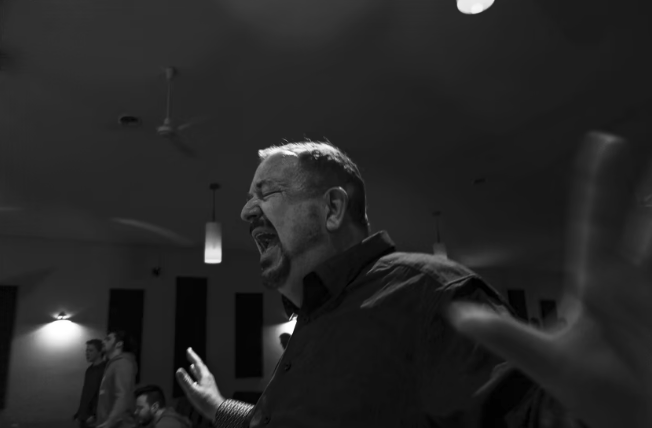
Bolin praying with FloodGate congregants in February. The pastor initially opposed Donald Trump’s candidacy, but he says he came to “love” the former president. (Jonno Rattman for The Atlantic)
In my ensuing visits to FloodGate, and in long conversations with Bolin, it became clear that this type of extreme political expression is central to his church’s identity, and to his own.
Bolin told me that after a troubled childhood in Southern California—he said he began drinking and doing drugs at age 9—he discovered an interest in political activism. He became infatuated with Robert F. Kennedy and Martin Luther King Jr., committing himself to the art of protesting: marches, sit-ins, hunger strikes. He was a “proud hippie” more interested in the occult than in any organized religion.
Then, when he was 20 years old, he was packing for a cross-country hitchhiking trip and discovered a Bible that had been given to him years earlier. “I lifted it up—and remember, I’m a supernaturalist—and felt like my arm was on fire,” Bolin told me. “And I heard a voice: ‘Return to me, or you will die.’ ”
Bolin got a ride to Reno, Nevada, where he had a Christian cousin. They went to church together. “There was an altar call, and I went down and got baptized that same afternoon,” Bolin said. “I’ve never been the same. It changed who I am.”
That change included his politics. Setting out on his Christian journey—working as a substance-abuse counselor, attending Bible college, pastoring in churches from California to Pennsylvania—Bolin found that many of his old stances were incompatible with his new faith. In particular, his views of abortion and religious freedom were turned upside down. One thing didn’t change. “I have always been prone to protesting,” Bolin told me. “Then and now.”
Much like Pastor Brown, Bolin married conservative theology to conservative ideology. But whereas Brown became disillusioned by the religious right’s hypocrisy and political ruthlessness, Bolin believes that evangelicals didn’t go far enough. “Christians have languished with their participation in politics,” he said, “which is one of the reasons we’re in this dire position as a nation.”
When Bolin arrived at FloodGate in 2010, the church—founded in 1972 and formerly called the Father’s House—was mostly apolitical. Bolin changed that. “Pastors used to be the primary influencers in their communities in determining who we elected,” Bolin said. He aimed to restore that tradition in his own ministry.
Some people left the church; others joined. All the while, his congregation hovered right around 100 people. He leaned into plenty of political controversies—including Trump’s candidacy—but his membership stayed flat. Looking back, it’s fair to wonder whether that’s because he was on the wrong side of that particular issue. “Donald Trump was the last person I wanted elected president,” Bolin said, letting go of a belly laugh. He thought Trump was a charlatan, a lifelong Democrat who was defrauding conservative voters.
“He proved me wrong,” Bolin said. “He turned out to be the most pro-life president we’ve ever had. His influence on the courts will change the country for the next 50 years.” Bolin sounded ashamed of having ever doubted Trump. He rattled off the former president’s accomplishments. He rolled his eyes at the “condescending” Christians who criticized Trump’s ethics. He defended the January 6 insurrection, which “was not a big deal.” In fact, Bolin himself nearly traveled to Washington that day “because a lot of people from our church were going, and because I love Donald Trump.”
The Trump conversion experience—having once been certain of his darkness, suddenly awakening to see his light—is not to be underestimated, especially when it touches people whose lives revolve around notions of transformation. And yet, it reflects a phenomenon greater than Trump himself. Modern evangelicalism is defined by a certain fatalism about the nation’s character. The result is not merely a willingness to act with desperation and embrace what is wrong; it can be a belief, bordering on a certainty, that what is wrong is actually right.
In the fall of 2016, Ken Brown informed his congregants that he planned to vote for Trump. His choice came down to abortion, he explained, and the Supreme Court appointments in the balance. Still, the pastor emphasized Trump’s personal failings and warned against political idolatry. He reminded his people that Christians aspire to a higher standard than “the lesser of two evils.” Brown felt confident they understood him.
His confidence was misplaced. Over the next four years, the pastor watched as many of his people became MAGA disciples. They were glued to Fox News. Some posted ugly, combative messages on social media. A few were devotees of Alex Jones, the internet-radio host famous for his hateful conspiracy theories.
When COVID arrived—bringing with it “a new flood of misinformation”—Brown and his leadership team wrote a letter to the congregation laying out their reasons for closing the church and specifying the sources they were relying on. Brown also launched a blog and a podcast, vying for his members’ attention at a moment when so many were suddenly stuck at home and swimming in hearsay and innuendo.
Jen Furkas, who began attending Community Bible in 2003, wondered if Brown’s efforts were coming too late.
“There are people at the church, people who I’d consider friends, who would have said very hurtful, very unbiblical things,” Furkas, the assistant principal of a local public school, told me. “And it didn’t just start during COVID.”
Furkas describes herself as a moderate Democrat—which, she joked, “makes me the most liberal person at our church.” When Trump became the Republican nominee and Pastor Brown shared his intention to vote for him, Furkas was so disappointed that she left the church.
She spent a year shopping around. But none of the other congregations felt right. One Sunday, Furkas came back to Community Bible and noticed something different about the place. “It was Ken,” she said. “He had changed. This wasn’t the same guy who was sold out to this mindset of Well, it all comes back to abortion and the courts. It was clear that he’d seen how this fanaticism had infected the church.”
Furkas recalled how, a few years ago, Brown delivered a sermon reminding everyone whom Jesus had come to save. Clicking through a PowerPoint on the sanctuary’s projector screens, Brown showed pictures of well-known faces. It was good for some laughs and lighthearted commentary. Then he put up a photograph of Ilhan Omar, the Democratic representative from Minnesota and a Muslim, wearing her hijab. “What about her?” Brown asked. “Did Jesus come for her?” The room was silent.
“I love the evolution from Ken,” Furkas said. “But I know it’s come at a cost.”
Every person I spoke with from Community Bible brought up the fact that some longtime members had quit the church. Brown acknowledged that his tactics had pushed some people away, but he shrugged off the number, saying “four or five families” and “a few individuals” had left. “Sometimes, when someone leaves,” he said, “that means you’ve been successful in protecting the rest of your flock.”
But not everyone who’s dissatisfied with a church leaves—at least, not right away. At a place like Community Bible, with a core of members who have been together for years, the concern isn’t necessarily a mass exodus. It’s a mass estrangement, in which people stop listening to the pastor or stop trusting one another—or both—and the church slowly loses its cohesiveness.
“What I worry about is people tuning Ken out—people who don’t like his politics, and because of that, they stop letting him be their pastor,” Bob Fite, a high-school history teacher who has attended Community Bible for more than a decade, told me. “And honestly, he’s making me nervous. I have tried to tell him, ‘Stay in your lane.’ ”
Fite said that Brown is “losing people” with his political agenda. One of those people is B.J. Fite—Bob’s son. B.J. was raised evangelical, graduated from Bob Jones University, and believes it’s his responsibility to be active in the Church. He’s just not sure anymore that Community Bible is a good fit for someone like him—deeply conservative, a Trump voter, a consumer of right-wing media.
When I met B.J. it was apparent that he was wrestling with whether to leave Community Bible. In fact, he said he’d been engaged in a weeks-long text exchange with Pastor Brown. B.J. was upset that Brown had released multiplepodcastepisodes vilifying the people responsible for the January 6 insurrection. He also resented the fact that Brown had written blog posts endorsing COVID vaccines and, B.J. felt, had minimized the concerns of people—like himself—who worried they would lose their jobs for refusing the shot.
“There are different truths in politics—Trump’s truth, Biden’s truth, whatever,” B.J. told me. “But in church, there’s supposed to be one truth. Why aren’t we just sticking to that truth?”
Bob Fite said he addressed these concerns in a letter to Pastor Brown and the leadership team. But nothing changed. Bob can’t imagine leaving the place he loves, the place where he and his wife, Valerie, teach Sunday school. But he also can’t imagine standing by while Brown pushes B.J. out the door.
“I’ve been going to church with a lot of apprehension,” Bob said. “I told Valerie, ‘One day, if Ken says the wrong thing, I might have to stand up and leave.’ ”
Bill Bolin knows something about people leaving. About 90 percent of his Sunday crowd at FloodGate has migrated from other congregations over the past two years. Almost all of them, he says, came bearing grievances against their former pastors. Yet most had never considered looking elsewhere. It took a pandemic, and the temporary closing of their churches, for them to sever ties.
As of the spring of 2020, Jeff and Deidre Myers belonged to Oak Pointe Milford, a suburban-Detroit church. Though they were frustrated that the preaching wasn’t more overtly political, they were highly engaged: leading a marriage ministry, active with other homeschoolers. They were even friends with the pastor, Paul Jenkinson, and his wife.
And then COVID hit. When the church closed, rumors flew about the board of elders holding contentious late-night meetings to debate pandemic protocols. The longer the church remained locked, the more people speculated on who was casting the deciding votes. Around that time, George Floyd was murdered. Oak Pointe Novi, the parent church, introduced a video series called “Conversations,” which featured interviews with Black pastors and social-justice activists.
“I thought I was going to vomit,” Deidre told me, recalling her reaction to one episode. Jeff added: “It was the pastor’s son”—who, he claimed, is said to be a member of antifa in Canada—“lecturing on white privilege and critical race theory.” (I could not confirm that the pastor’s son is, in fact, a member of antifa in Canada; several people who know the family laughed when I asked the question.)
Deidre saw friends from other congregations, also displaced by shutdowns, posting on Facebook about FloodGate. The first service she attended—in which Pastor Bolin unapologetically advocated for people, like Jeff and Deidre, who felt cheated by their old churches—brought her to tears. Jeff was equally moved. They had found a new home.
When Jeff and Deidre met with Jenkinson to inform him that they were leaving the Milford church, tensions ran high. Their worst fears had already been confirmed: A friend on the elder board had told them that Jenkinson—their pastor, their friend—had argued to keep the church closed. Jeff and Deidre pressed Jenkinson on the church’s refusal to engage with politics. When they asked the pastor why, despite being personally pro-life, he had never preached on abortion, they got the response they’d dreaded. “He said, ‘I’d lose half my congregation,’ ” Jeff recalled.
Jenkinson remembers the conversation somewhat differently. Jeff and Deidre, he tells me, weren’t just pushing him on abortion; they were challenging the pastor’s policy of political neutrality from the pulpit, and accusing him of taking the easy way out of the debates fracturing his church.
“And I remember telling them, ‘The harder thing to do is what I’m doing,’ ” the pastor says. “This is how you lose people. How you gain people is, you pick a tribe, raise the flag, and be really loud about it. That’s how you gain a bunch of numbers. That is so easy to do. And it cheapens the Gospel.”
Whatever the specifics of their exchange, to Jeff and Deidre, Jenkinson’s stance amounted to cowardice. “I realize these are hard conversations, but the reason we left Milford is they were never willing to have the conversation,” Jeff said. “They were just trying to keep everybody happy. Paul is a conservative, but his conservatism has no teeth.”
Tony DeFelice is another new arrival at FloodGate—and another Christian who got tired of his pastor lacking teeth. At his previous church, in the Democratic-leaning Detroit suburb of Plymouth, “they did not speak a single word about politics. Not on a single issue,” he told me. “When we got to FloodGate, it confirmed for us what we’d been missing.”
DeFelice, a building inspector, had been attending the Plymouth church for 14 years when the pandemic began. He and his wife, Linda, had friends and family there; one of their daughters still works on the church staff. Tony and Linda had their share of complaints—the church was too moderate and “too seeker-friendly,” catering more to newcomers than longtime Christians—but they had no plans to leave.
And then, in March 2020, everything fell apart.
“We didn’t leave the church. The church left us,” Tony told me. “COVID, the whole thing, is the biggest lie perpetrated on humanity that we’re ever going to see in our lifetime. And they fell for it.”
Tony and Linda say FloodGate’s style—and Bolin’s fiery messages on topics like vaccines and voter fraud—has changed the way they view their responsibilities as Christians. “This is about good against evil. That’s the world we live in. It’s a spiritual battle, and we are right at the precipice of it,” Tony said.
With the country on the brink of defeat at the hands of secularists and liberals, Tony no longer distinguishes between the political and the spiritual. An attack on Donald Trump is an attack on Christians. He believes the 2020 election was stolen as part of a “demonic” plot against Christian America. And he’s confident that righteousness will prevail: States are going to begin decertifying the results of the last election, he says, and Trump will be returned to office.
“The truth is coming out,” Tony told me.
When I pressed him on these beliefs—offering evidence that Joe Biden won legitimately, and probing for the source of his conviction—Tony did not budge. He is just as convinced that Trump won the 2020 election, he said, as he is that Jesus rose from the dead 2,000 years ago.
Nestled in a wooded stretch of exurban Wilson County, Tennessee, the campus of Greg Locke’s Global Vision Bible Church feels more like a compound. Heaps of felled oak trees border the property, evidence of hurried expansion. A rutted gravel parking lot climbs high away from the main road. At the summit stands an enormous white tent. A sign reads This Is A MASK FREE Church Campus.
The old Global Vision building (right) held about 250 people. Now the congregation gathers in a tent that fits 3,000 (left). (Jonno Rattman for The Atlantic)
Inside, men wearing earpieces and camouflage pants guard the entrance. Behind them, many hundreds of people jump up and down on a floor of cedar chips. Locke salutes them as “soldiers rising up in God’s army.” Some hear this more literally than others: I spot a few folks carrying guns.
If this all sounds a bit strange—ominous, or even “dangerous,” as one local pastor warned me the night before I visited—well, sure. But strange compared to what? Having spent my entire life in and around the evangelical Church, I had in recent years become desensitized to all the rhetoric of militarism and imminent Armageddon. The churches that host election-fraud profiteers and weeknight speakers denouncing the pseudo-satanic agenda of Black Lives Matter—churches that consider themselves mainstream—were starting to feel like old hat. It was time to visit the furthest fringes. It was time to go see Greg Locke.
Not long ago, Locke was a small-time Tennessee preacher. Then, in 2016, he went viral with a selfie video, shot outside his local Target, skewering the company’s policies on bathrooms and gender identity. The video has collected 18 million views, and it launched Locke as a distinct evangelical brand. He cast himself on social media as a lone voice of courage within Christendom. He aligned himself with figures like Dinesh D’Souza and Charlie Kirk to gain clout as one of the Christian right’s staunchest Trump supporters. All the while, his congregation swelled—moving from their old church building, which seated 250, into a large outdoor tent, then into an even bigger tent, and eventually into the current colossus. The tent holds 3,000 people and would be the envy of Barnum & Bailey.
Which is fitting—because what’s happening at Global Vision can feel less like a revival than a circus.
One Sunday morning in November, Locke, prowling the stage in a bright-orange tie, asks how many people have traveled to his tent from outside Tennessee. Scores of people stand up. “And this is every weekend!” Locke cries in his hickory drawl. Eager to put on a show for the visitors, Locke announces that his special guest—he tries to book one every Sunday—is the actor John Schneider, who played Bo Duke on The Dukes of Hazzard. The crowd erupts and everyone hoists their phone in the air, heralding Schneider’s arrival like Catholics awaiting the pope.
Schneider has come to speak and sing. There’s such energy that even some very serious-looking men—dressed in paramilitary gear, firearms strapped to their sides—bounce on their toes and clap along. Between songs, Schneider offers a different catalog of greatest hits. He talks about the flu shot making someone sick. He decries the Christian elites who look down on people like him. He hints at a potential violent uprising.
“We are born for such a time as this. God is calling you to do something,” Schneider says. “We have a country to get back. And if that fails, we have a country—yes, I’ll say it—to take back.”
Locke’s sermon is about the Philistines of the Old Testament stealing the Ark of the Covenant from the Israelites, because they sensed that the only way to defeat God’s chosen people was to separate them from God. The same thing is happening in America today, Locke warns. Liberals have devised a plot to separate Christians from God. And all too many Christians—under the guise of a “plandemic”—are allowing it to happen.
Worshippers at Global Vision Bible Church, in Tennessee, in April (Jonno Rattman for The Atlantic)
“Let me tell you something,” Locke says, his voice rising. “I ain’t never had a prostitute mad at me for keeping this church open! I ain’t never had a wino or a drunkard [come] in here and say, ‘I can’t believe you!’ I ain’t never had a crackhead mad for keeping this church open! But I get letters from preachers all the time: ‘Oh, Brother Locke, you just need to take a chill pill. We feel like you’ve shamed us.’ ”
Locke starts nodding. “I have! Every last one of them cowards, I’ve shamed all of them!” The audience leaps to its feet again. “Shame, shame, shame!” he shouts, wagging a finger.
Listening to Locke that morning, I felt a peculiar sort of disappointment. There was nothing sui generis about the man or this Sunday service. Locke said nothing I hadn’t heard from other pastors. Atmospherics aside—it’s not every day you worship inside a tent next to an armed man wearing an Alex Jones shirt—the substance was familiar and predictable to the point of tedium.
Let’s be clear: Locke belongs to a category of his own. He recently accused multiple women at his church of being witches (his source: a demon he encountered during an exorcism). That makes it easy for evangelicals to dismiss Global Vision as an outlier, the same way they did Westboro Baptist. It’s much harder to scrutinize the extremism that has infiltrated their own church and ponder its logical end point. Ten years ago, Global Vision would have been dismissed as a blip on Christianity’s radar. These days, Locke preaches to 2.2 million Facebook followers and has posed for photos with Franklin Graham at the White House.
Walking out of Global Vision, I asked myself: How many pastors at smaller right-wing churches—pastors like Bolin—would have felt uneasy sitting inside this tent? The answer, I suspect, is very few. Global Vision and FloodGate may be different in degree, but they are not different in kind.
This mission creep inside evangelicalism is why some churches have taken an absolutist approach: no preaching on elections, no sermons about current events.
“The second you get into any of the political stuff, you start losing focus,” Michael Bingham, the lead pastor at Aldersgate United Methodist Church, in Greenville, South Carolina, told me during a visit last fall. “Some people say, ‘Well, you have to preach on abortion.’ Okay. But then something else happens in the culture—and if you preached on abortion, well, you better preach on voting rights. Or gun rights. Or immigrants. I’ve just decided I’m not touching any of it.”
Bingham has been a pastor in the UMC for nearly 25 years. Over that time, he says, he’s watched as political disputes have traveled from the periphery of church life to the heart of it. Despite being personally conservative on most issues—and estimating that two-thirds of the church agrees with him—Bingham has maintained a posture of unflinching neutrality from the pulpit.
He has two reasons. First, Bingham simply does not believe that pastors should contaminate the Gospel with political talk. Second, and of more immediate relevance when we spoke, the United Methodist Church was finalizing plans for a denominational divorce over core social divisions, including whether to ordain gay ministers. Under the tentative plans, individual churches will vote on whether to break away and join the new conservative denomination or side with the liberals and remain under the existing UMC umbrella.
With rumors of this imminent split roiling Aldersgate, Bingham told me, the last thing he wanted was to exacerbate tensions within his church. Plenty of people there know that he’s a conservative. They also know that his deputy, Johannah Myers, is a committed progressive. But the pair were working diligently to keep any trace of those political disagreements out of church life. “We are doing everything we can to hold this place together,” Myers told me.
But what is left to hold together? When I visited, the church—an elegant structure with room for 500 in the sanctuary—was hosting maybe 150 people total across two Sunday services. Bingham is proud to say that he hasn’t driven anyone away with his political views. Still, membership has been in decline for years, in part because so many Christians today gravitate toward the places that are outspokenly aligned with their extra-biblical beliefs.
For all their talk of keeping Aldersgate unified, Bingham and Myers acknowledged that in a few years’ time, they would belong to different churches. The same went for their members. When I met with some of the longest-tenured laypeople of the church, almost everyone indicated that when the UMC divorce was finalized, they would follow the church that reflected their political views. It didn’t matter that doing so meant, in some cases, walking away from the church they’d attended for decades.
“What’s coming is going to be brutal. There’s no way around that,” Bingham told me. “Churches are breaking apart everywhere. My only hope is that, when the time comes, our people can separate without shattering.”
Ken Brown knows plenty of pastors like Bingham, who refuse to talk about the very things tearing their churches apart. He knows they have their reasons. Some don’t know what to say. Others fear that speaking up would only make matters worse. Almost everyone is concerned about job security. Pastors are not immune from anxiety over their mortgage or kids’ college tuitions; many younger clergy members, in particular, worry that they haven’t amassed enough goodwill to get argumentative with their congregation.
Brown is grateful that, after 20 years leading Community Bible, he gets lots of latitude from his congregation. He hears the grousing that his political commentary takes the focus off Jesus, but his entire rationale rests on the belief that Jesus long ago became a secondary focus for some in the church. “I need to do better explaining why I’m dropping these comments in such a volatile cultural environment. Some people feel like I’m just dropping random anti-Trump bombs,” Brown said. “But if I didn’t see Trump—and Trumpism—as a danger to our mission, they would never hear me say anything about Trump.”
Brown has informed the church that he’s headed toward retirement. He’s searching for a successor and hopes in a few years to transition into a support role. He says the new lead pastor doesn’t necessarily need to share his approach to the crises of discernment and disinformation. But this only adds to the urgency of fortifying Community Bible.
The pastor is pushing harder than ever, and he feels, for the first time, that momentum is on his side. Many of his members, Brown said, have told him over the past year that they swore off cable news or deleted their social-media accounts; not coincidentally, some of them seem more engaged with scripture than ever before. There are still holdouts, Brown said, people who’d prefer the church to go in another direction. But that only validates his approach: Without this intervention, how much worse off might Community Bible be? “I can’t prove what would have happened,” Brown said, “but my guess is that our church would have descended into the sort of war zone that other churches have become.”
There are days when Brown envies his colleagues from other churches who haven’t waded into this fight. It would be simpler to spend his final years as a lead pastor sticking to scripture. But whenever he considers that temptation, Brown says he is reminded of a favorite passage. In the Book of John, Chapter 10, Jesus warns of the “hired hand” who puts his own safety ahead of the flock’s: “So when he sees the wolf coming, he abandons the sheep and runs away.”
Brown believes he’s been called to be a shepherd. The hired hand, he says, is no better than the wolf.
Sitting inside a cramped office at the back of FloodGate, Bill Bolin is second-guessing himself.
We’ve talked at length about extremism in his church—the people who were certain that Trump would never leave office, the people who swear by QAnon—and Bolin seems, at some level, to genuinely be reckoning with his role in it. He says he’s worried about Christians getting their priorities mixed up. He tells me he doesn’t want his rants about Biden or the 2020 election—which are “nonessentials”—to be taken with the seriousness of his statements about Jesus, which are the “essentials” people should come to church for.
“I do make a separation between our religious perspective and our political perspective,” Bolin tells me. “I don’t view political statements as being infallible.”
That’s putting it generously. In the time I spent listening to Bolin preach, sitting with him for interviews, and following his Facebook page, I recorded dozens of political statements that were either recklessly misleading or flat-out wrong. When I would challenge him, asking for a source, Bolin would either cite “multiple articles” he had read or send me a link to a website like Headline USA or Conservative Fighters. Then he would concede that the claims were in dispute, and insist that he didn’t necessarily believe everything he said or posted.
It seemed a dangerous practice for anyone, let alone someone trusted as a teacher of truth. Many of the backwater websites and podcasts Bolin relies on for political information were the same ones cited to me by people from his church. In a sense, Christians have always lived a different epistemological existence than nonbelievers. But this is something new—and something decidedly nonessential.
At one point, I show Bolin a Facebook post he wrote months earlier: “I’m still wondering how 154,000,000 votes were counted in a country where there are only 133,000,000 registered voters.” This was written, I tell him, well after the Census Bureau had published data showing that more than 168 million Americans were registered to vote in 2020. A quick Google search would have given Bolin the accurate numbers.
“Yeah, that’s one I regret,” he tells me, explaining that he subsequently learned that the numbers he’d posted were incorrect. (The post was still active. Bolin texted me the following day saying he’d deleted it.)
Doesn’t he worry that if people see him getting the easy things wrong, they might suspect he’s also getting the hard things wrong? Things like sanctity and salvation?
“I really don’t. No. Not too much. I don’t,” Bolin says, shaking his head. “Firebrand statements have been part of the pulpit, and part of politics, for as long as we’ve been a nation. And there is a long history of both sides exaggerating—like in a post like that.”
Still, Bolin seems rattled. He begins telling me about a couple of Democrats who attend FloodGate and have rebuked him for his political rhetoric—but who reassure him, Bolin says, “When it comes to the Word, you’re rock-solid.” Then he tells me something surprising: He’s thinking of scaling back “Headline News” on Sunday mornings. Maybe he’ll just read news clips verbatim, he says, without adding commentary. Or maybe he’ll cut the political headlines in half, adding some “feel good” news to balance the mood. The more he thinks about it, Bolin says, he might just cut the segment altogether, posting those political musings on Facebook but keeping them out of worship.
“We’re now going from pandemic to endemic. Our culture will change. There will no longer be this massive division over COVID,” Bolin says. “The fervency is going to die down.”
Except there will always be something new. Literally moments before he talked about the fervency dying down, Bolin previewed a shtick he was going to deliver on Sunday morning about Apple adding a “pregnant-man emoji” to the iPhone.
Bolin had diagnosed in some detail “the sorting” within evangelicalism—the scramble of Christians switching congregations, churches rising and falling, pastors adapting or heading for the exits. It occurs to me, while he discusses these potential changes, that no church is guaranteed anything. The moment Bolin stops lighting fires from the pulpit at FloodGate, how many of its members—who are now accustomed to that sort of inferno, who came to FloodGate precisely because they wanted the heat—will go looking for them elsewhere?
That’s not a risk he seems willing to take. Bolin tells me the church has sold the building we’re sitting in—where the congregation has met since the 1970s—and purchased a sprawling complex down the road. The pastor says FloodGate’s revenue has multiplied sixfold since 2020. It is charging ahead into an era of expansion, with ambitions of becoming southeast Michigan’s next megachurch.
Bolin says FloodGate and churches like it have grown in direct proportion to how many Christians “felt betrayed by their pastors.” That trend looks to be holding steady. More people will leave churches that refuse to identify with a tribe and will find pastors who confirm their own partisan views. The erosion of confidence in the institution of American Christianity will accelerate. The caricature of evangelicals will get uglier. And the actual work of evangelizing will get much, much harder.
God isn’t biting his fingernails. But I sure am.
This article appears in the June 2022 print edition with the headline “How Politics Poisoned the Church.”
May 10, 2022 at 11:20AM MSNBC Guest Says She Wants To Make ‘Sweet Love’ To Roe Leaker And ‘Joyfully Abort Our Fetus’
Gone are the days of ‘safe, legal, and rare’ abortion advocacy that Democrats used to claim to support. Democrats now openly celebrate abortion and joke about it on liberal news networks.
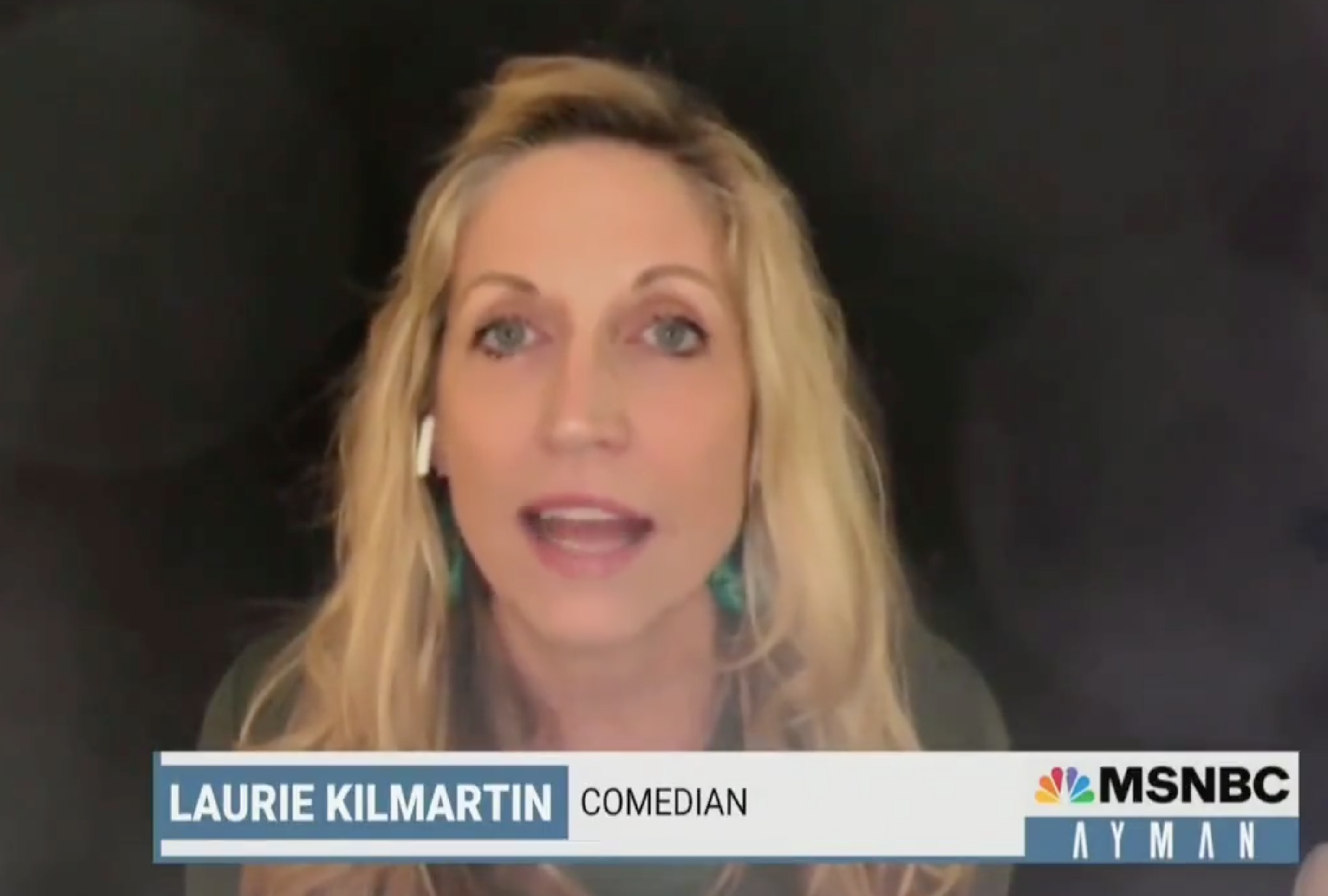
Today, MSNBC invited Conan O’Brien writer Laurie Kilmartin on to their show to discuss abortion and the recent Roe v. Wade draft opinion leak. Kilmartin said that she would like to thank the leaker by making love to them and aborting the child that they would hypothetically conceive.
“Here’s my feeling about the leaker. I would like to find out who the leaker is, so I could make sweet love to that person, because that person is a hero to me. Okay?” Kilmartin began. “And if the leaker — a lot of people are saying it could be a conservative — if the leaker is a Republican, and if I get pregnant during our lovemaking, I will joyfully abort our fetus, and let them know.”
Mohyeldin and the other guests laughed at the joke.
“I don’t know if that answered your question,” Kilmartin continued. “I probably didn’t.”
The host replied that it was “a little off-topic.”
After making the disgusting joke, Kilmartin said that old Democrats should go on a hunger strike to defend abortion, because they “don’t have much longer (to live) anyway.” She urged them to be the ‘Bobby Sands’ of abortion. Bobby Sands was an IRA terrorist who helped plan the bombing of the Balmoral Furniture Company in Belfast.
May 10, 2022 at 03:22PM Elon Musk Would Reverse Donald Trump’s Permanent Ban From Twitter, He Says
Twitter Inc. was “foolish in the extreme” in kicking former US President Donald Trump off its service and his permanent ban should be ended, said Elon Musk, the billionaire who has agreed to acquire the social media company.
“I would reverse the permanent ban,” Musk said Tuesday at a Financial Times conference, in response to a question that asked him directly about Trump. “Perma bans just fundamentally undermine trust in Twitter as a town square where everyone can voice their opinion.”
Booting the former president off the site “didn’t end Trump’s voice,” Musk said. “It will amplify it among the right. This is why it is morally wrong and flat-out stupid.”
“My opinion, and Jack Dorsey I want to be clear shares this opinion, is that we should not have permanent bans,” Musk said, referring to the Twitter co-founder and former chief executive officer. Dorsey tweeted his agreement, and both men added caveats that illegal behavior or spam wouldn’t be allowed.
Musk, who reached an agreement to acquire Twitter for roughly $44 billion late last month, has said that he believes the San Francisco-based company has overstepped on policing user speech and wants to push it toward a more free-speech-focused approach.
But Musk also cast a bit of doubt about whether the deal, which would make Twitter a private company, will go through. He’s still in the process of lining up the necessary funding to complete the transaction.
“I don’t own Twitter yet, so this is not like a thing that will definitely happen,” he said. “What if I don’t own Twitter?”
Trump has said he won’t return to the service even if the ban is lifted. He is backing his own social media company, called Truth Social. A Trump spokesman didn’t immediately respond to a request for comment on Musk’s remarks.
U.S. District Judge James Donato last week threw out the former president’s challenge to his permanent ban from Twitter. The San Francisco judge gave Trump’s lawyers a chance to revise the suit and try again, but warned they will have to show that Twitter was acting as a government censor.
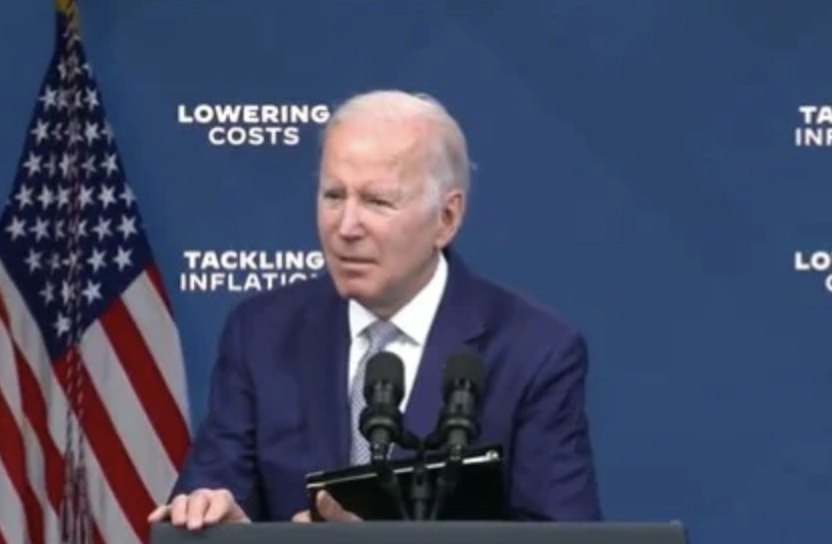
CBS reporter Ed O’Keefe: Earlier today, anticipating your remarks, he said, and I’m just quoting here. He said that the best thing that, the most effective thing that Joe Biden can do to solve the inflation crisis he created, is resign. He’s the problem.
Joe Biden responded, “Resign, that’s a good idea.”
No joke.
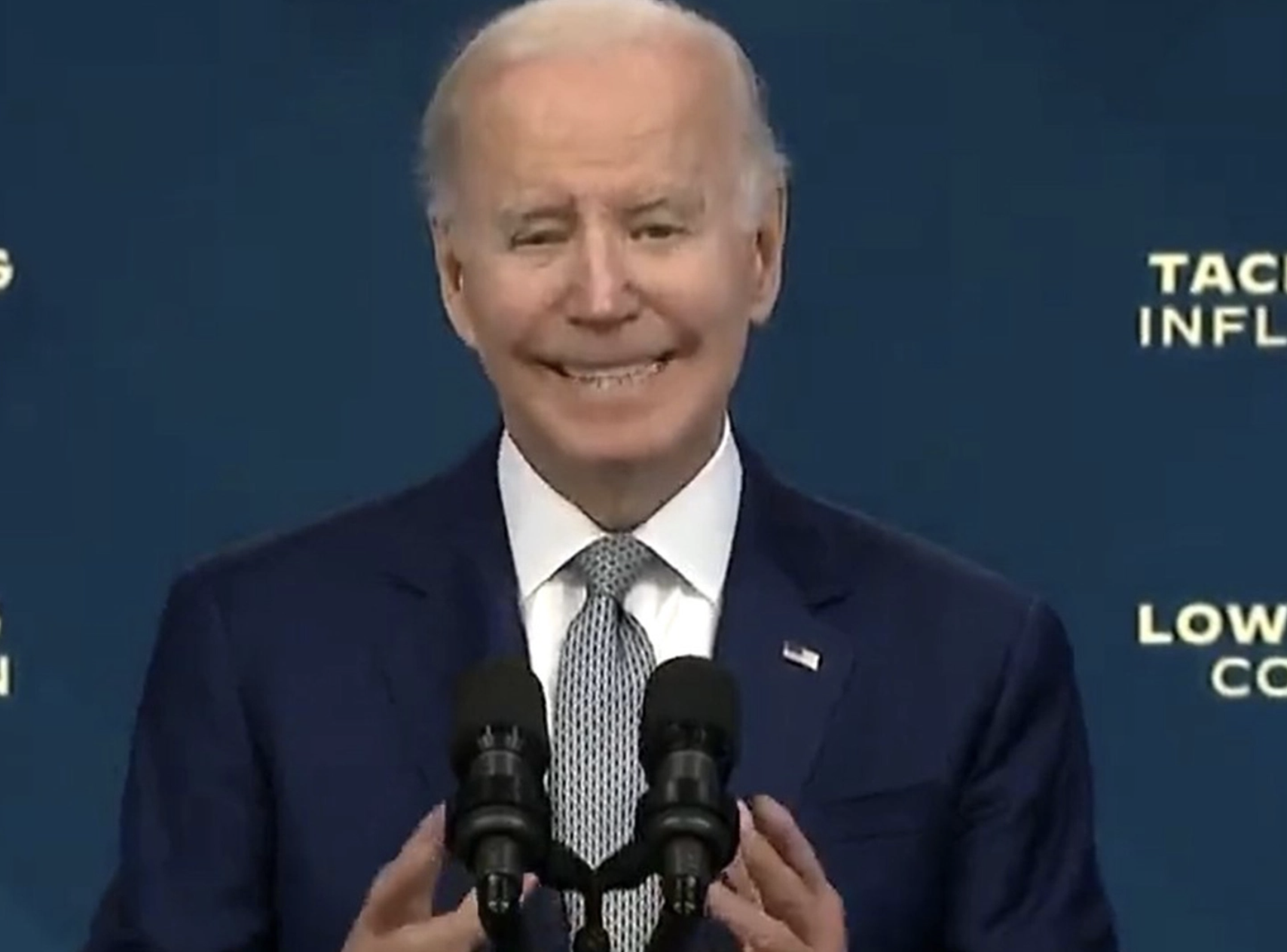
Here is the exchange. Joe Biden appears proud of his response.
Former President Bill Clinton once said “I feel your pain” but President Joe Biden has another slogan.
During a press conference on Tuesday about rising inflation he said he could “taste” the frustration of Americans.
“Look, I know you gotta be frustrated. I know! I can taste it,” the president said towards the end of his press conference, for which he was roundly ridiculed on the Internet.
“It’s a little late for Biden to note that people are unhappy with him while denying any responsibility when he’s deeper underwater than Ted Kennedy’s car on Chappaquiddick,” Spencer Brown said.
Advertisement
“I know,” Biden whispers of the “frustration” of Americans. “I can taste it,” he adds, bizarrely.
It’s a little late for Biden to note that people are unhappy with him while denying any responsibility when he’s deeper underwater than Ted Kennedy’s car on Chappaquiddick. pic.twitter.com/IGDmYhF6My
— Gissur Simonarson ??????????? (@GissiSim) May 10, 2022
“Don’t worry guys, Biden can “taste” that Americans are frustrated. I’m sure that’s a major comfort for families struggling to make ends meet under,” Gates McGavick said.
Don’t worry guys, Biden can “taste” that Americans are frustrated. I’m sure that’s a major comfort for families struggling to make ends meet under #Bidenflation
During the press conference the president continued to blame everyone, including “Ultra MAGA Republicans” and Russian President Vladimir Putin for price increase as he took no responsibility himself.
“Reporter: do you take any responsibility, your policies?” on reporter said to him.
“I think our policies help, not hurt. Think about what they say. The vast majority of the economists think that this is going to be a real tough problem to solve, but it’s not because of spending. We brought down the deficit. The bottom line is how much does America owe? How much in the hole are we going? We’re reducing that,” he said.
And during the press conference he actually blamed Americans who blame him for inflation because they are not being focused.
“I think that, you know, it’s – they’re not focused. All they’re focused on understandably is the problem they’re facing. They get 5 1/2% raise, average raise on their salaries and yet inflation exceeds that. And look around the world and they know that a lot of it is extremely complicated. And so they’re frustrated and I don’t blame them. I really don’t blame them. There’s a lot we have to do but you know as well – I shouldn’t say you. I think what I have to do is explain in simple, straightforward language what’s going on. Like reason why 30% of the inflation last year is because automobiles cost more. Why do they cost more? They couldn’t get the computer chips to make them,” he said.
And, of course he blamed MAGA Republicans.
“Let’s do one more comparison. Let’s compare our two plans when it comes to the deficit. Republicans love to attack me as a big spender, as if that’s the reason why inflation has gone up. Let’s compare the facts. Under my predecessor, the deficit exploded, raising every single year under Republicans. Under my plan, we’re on track to cut the federal deficit by $1.5 trillion this year. Let me say it again, $1.5 trillion by the end of this fiscal year. The biggest one-year decline in all of history for America. That’s in addition to last year we cut the budget $350 billion — the deficit, not the budget. The deficit, $350 billion. My Treasury Department is planning to pay down The National debt this quarter which never happened under my predecessor. Not once. Not once. Because unlike my predecessor, the deficit has gone down both years I’ve been here. That is not an abstraction. It matters. It matters to families. Because reducing the deficit is one of the main ways we can ease inflationary pressures.
Look, the bottom line is this. Americans have a choice right now between two paths, reflecting two different sets of values. My plan attacks inflation and grows the economy by lowering costs for working families, giving workers well-deserved raises, reducing the deficit by historic levels, and making big corporations and very wealthiest Americans pay their fair share. The other path is the ultra MAGA plan put forward by congressional Republicans, to raise taxes on working families, lower the income of American workers, threaten sacred programs, Americans count on like social security, Medicare and Medicaid and give break after break to big corporations and billionaires. Just like they did the last time they were in power. When their top priority was the reckless $2 trillion tax cut going majority — going to the very wealthiest Americans which ballooned the deficit and not a penny of it was paid for.
Look, I know you got to be frustrated. I know. I can taste it. Frustrated by high prices by gridlock in Congress, by the time it takes to get anything done. Believe me, I understand the frustration. But the fact is congressional Republicans, not all of them, but the MAGA Republicans are counting on you to be as frustrated by the pace of progress which they’ve everything — they’ve done everything they can to slow down, that you’ll hand power over to them and enact — so they can enact their extreme agenda. Look at their agenda. We’ll put it up on a web page somewhere. I think I can do this, the Scott plan. It’s in writing. We need a government focused on what families actually need. That’s why I urge all Americans to think about the path I’ve laid forward. We have to do more beyond what I laid forward. But then think about the Republican in Congress who are actually proposing. Which path is right for you and for your family and quite frankly, for America? Let’s build an extraordinary process and progress we’ve made instead of tearing it down. Let’s focus on what matters, what really matters to average Americans. I want to thank you all. God bless you. And may God protect our troops.”
And the president blamed Putin.
“Let me explain why this choice is so important. Let me start with the Putin price hike, high gas prices and energy prices. My plan is already in motion. I led the world and other countries to join with us to coordinate the largest release of oil from our stockpiles of all the countries in history, 240 million barrels to boost global supply. Here at home U.S. oil and gas production is approaching record levels. In fact, we produced more oil domestically in my first year in office than my predecessor did in his first year.
To further drive down prices, my administration is allowing the sale of gasoline using home grown bio fuels, bio fuels this summer, which wasn’t allowed before. And to reduce our dependence on foreign oil, and reckless autocrats like Putin, I’m working with Congress to pass landmark investments to help build a clean energy future as well. From tax credits for businesses to produce renewable energy to tax credits for families to make their homes more energy efficient.”
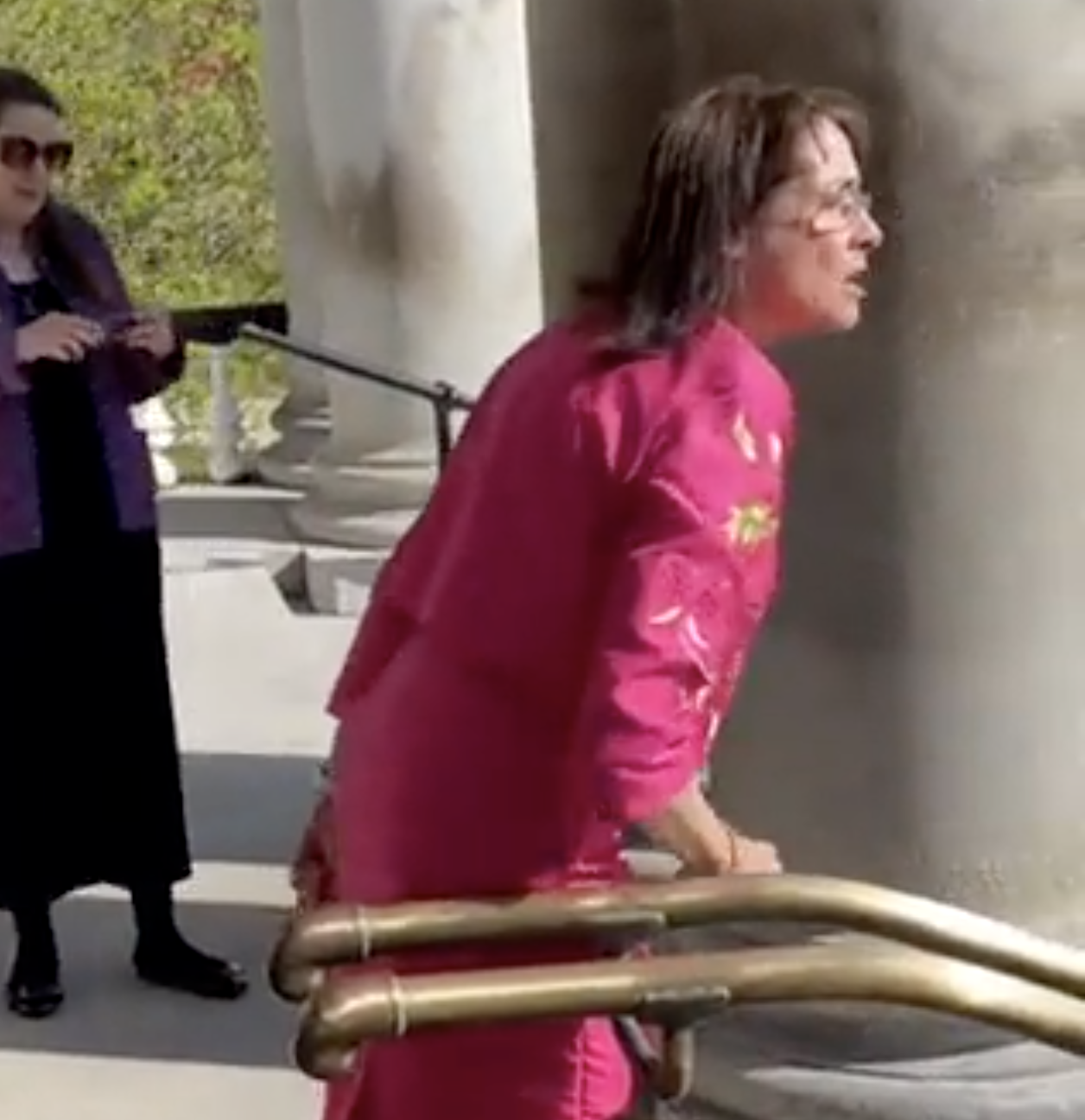
Susan DeLemus, a New Hampshire Republican state Representative, stunned reproductive rights activists after she referred to them as “murderers” from the steps of the New Hampshire State House.
DeLemus, who has been a fixture in New Hampshire local politics since 2010, rightfullu accused activists of “killing babies” and claimed she’d murdered her own, referring to an abortion she’d had more than two decades ago.
She continued to yell at activists for some time, even pointing directly at some of them while continuing to claim they are murdering their children.
“Shame on you! Shame on you! Shame on all of you! Shame on all of you killing babies!”
[pointing at different activists] “You’re a murderer! You’re a murderer! You’re a murderer!”
“I’m a murderer! I murdered my own baby!”
“Shame on you! Shame on you! Shame on all of you!”
The incident occurred as “reproductive rights” activists (code for baby-killer) have rallied around the nation in response to a leaked draft opinion that indicated the Supreme Court’s ruling on Dobbs v. Jackson Women’s Health Organization will move to strike down Roe v. Wade, the 1973 landmark decision that protects a person’s right to choose reproductive healthcare without excessive government restriction.
While the news has galvanized liberals who’ve sounded the alarm on what they say is a crucial human rights issue, it has nonetheless envigorated conservatives.
The draft opinion would have sweeping ramifications, resulting in abortion bans in roughly half the country, and comes as Republican-led legislatures nationwide have moved swiftly in recent weeks to curb the right to an abortion and have signaled efforts to further limit access to contraception.
The footage of DeLemus’ outburst quickly went viral & vial baby-killing communists call for her removal from office
In 2012, DeLemus revealed that she’d had an abortion during an argument in favor of a bill that would require a woman to wait 24 hours before undergoing an abortion.
She said she had an abortion in the late 1980s, an experience that prompted her to declare that “I have murdered my baby.” She said at the time that she might have changed her mind about undergoing the procedure if she had been made to wait 24 hours.
DeLemus is married to Jerry Delemus, who served an 87-month prison term for his participation in the 2014 Bundy protest, which leftists wrongfully describe as “an armed confrontation between supporters of extreme anti-government cattle rancher Cliven Bundy and law enforcement that took place after federal agents moved to seize cattle because Bundy had not paid grazing fees.” It was a protest to demand the County Sheriff’s intervention after heavily armed federal agents threatened the lives of unarmed protestors.
Jerry DeLemus previously served as co-chairman of then-candidate Donald Trump’s 2016 New Hampshire veterans coalition and is a member of the Oath Keepers — an organization that has been infiltrated and run by the FBI so that the left could demonize their opposition as “a far-right anti-government militia whose members participated in the attack on the United States Capitol.”
Susan Delemus’s husband Jerry was falsely charged for participating in an “armed confrontation” (he wasn’t even at Bundy Ranch on April 12th), held in federal detention without receiving due process, and then given the maximum sentence by an Obama/Harry Reid appointed, brown-robed La Raza judge Gloria Navarro.
Bill Gates Wants to Create a 3,000 Person Social Media Unit to Quash “Vaccine Misinformation”
Billionaire Bill Gates has announced that he plans to create a new unit, hiring 3,000 people to take to social media, put out messaging, and “help propagate accurate vaccine information in the future,” CNBC reported.
Gates wants social media to be a place with “good messages” from “people of trust in the community, such as political and ethnic leaders.”
Gates made the statements when being asked about Elon Musk’s acquisition of Twitter and the future of free speech on the platform.
During the Wall Street Journal’s CEO Summit, the Microsoft founder said Elon Musk could make Twitter worse. While the Tesla CEO is a free speech absolutist, Gates has called for more censorship.
Gates acknowledged that Musk has done a great job with his other companies, SpaceX and Tesla. But he is not confident Musk will do the same with Twitter.
“I kind of doubt that will happen this time, but we should have an open mind and never underestimate Elon,” he said.
One of the reasons Gates feels Musk could make Twitter worse is the SpaceX CEO’s stand on free speech.
“How does he feel about something [on Twitter] that says ‘vaccines kill people’ or that ‘Bill Gates is tracking people?’” Gates asked.
“What are his goals for what it ends up being? Does that match this idea of less extreme falsehoods spreading so quickly [and] weird conspiracy theories? Does he share that goal or not?” Gates said.
Gates feels social media platforms have a role to play to prevent misinformation from spreading.
“When you don’t have the trusted leaders speaking out about vaccines, it’s pretty hard for the platform to work against that,” he admitted. “So I think we have a leadership problem and we have a platform problem.”
“The way that you make those platforms spread truth and not crazy stuff, there’s some real invention required there,” Gates said.
“It’s a huge problem in terms of legitimacy of elections or medical innovations … any sort of collective behavior,” he added.
Censorship of vaccine skepticism and “fact-checking” labels have been controversial policies on social media platforms during the pandemic.
Insane Clown and Disinformation Czar Nina Jankowicz Wants “Trustworthy People” Like Herself to be Able to Add Context to Other People’s Tweets
The Biden regime recently launched a Ministry of Truth department as a part of Homeland Security. To head the ministry they appointed a smug, leftwing, lunatic as their “director of misinformation.”
DHS Secretary Alejandro Mayorkas who is supposed to be securing the border announced that Nina Jankowicz will head up this new office earlier this month.
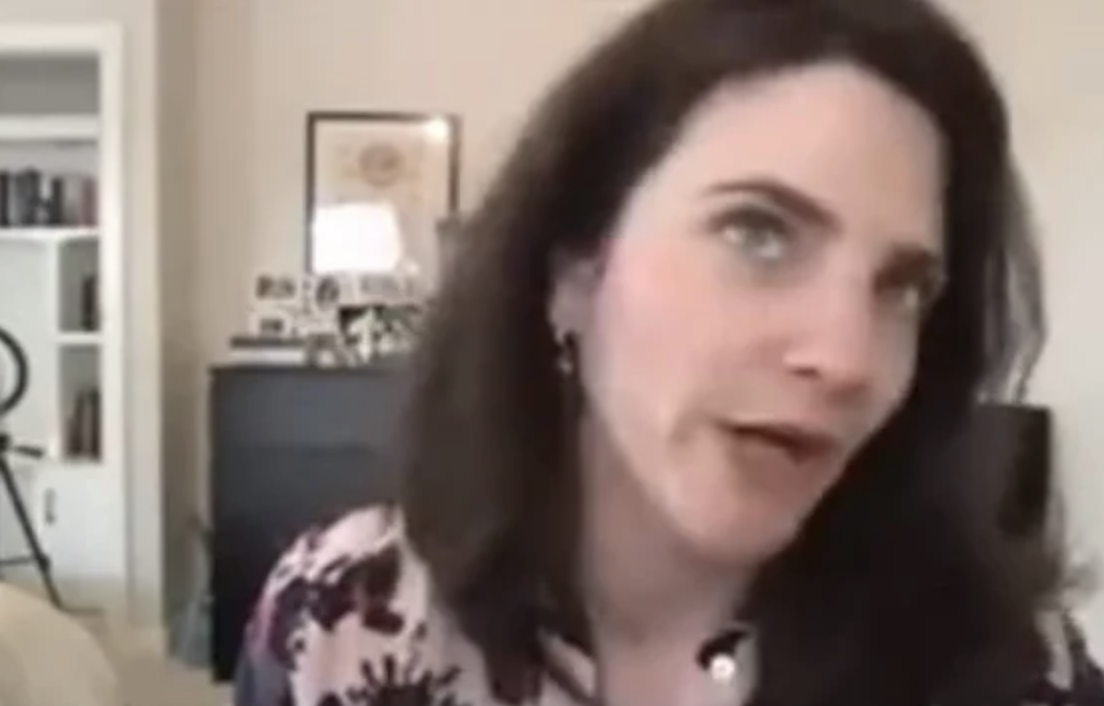
Nina Jankowicz, who has been completely wrong on most major news stories in the past 5 years, says only “trustworthy” people like herself should be verified on Twitter and able to add context to other people’s tweets.
This lady is such a narcissist and such a clown.
Here is the video.
NEW – Biden’s new “disinformation” czar wants “trustworthy verified people” like her to be able to “add context” to other people’s tweets.pic.twitter.com/V4mLNsB5HV