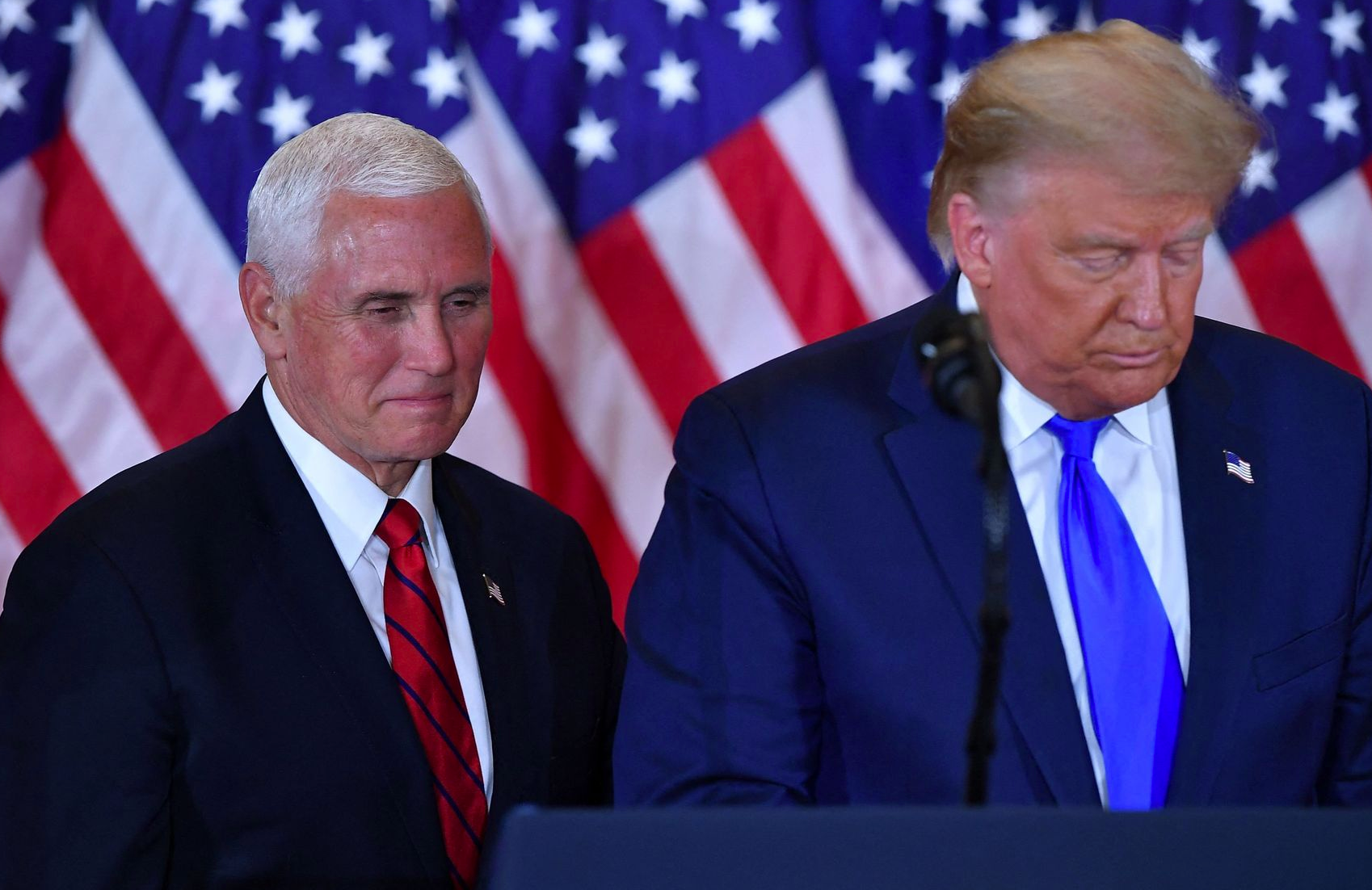
Thirteen days after the 2020 election, I had lunch with President Trump. I told him that if his legal challenges came up short, he could simply accept the results, move forward with the transition, and start a political comeback, winning the Senate runoffs in Georgia, the 2021 Virginia governor’s race, and the House and Senate in 2022. Then he could run for president in 2024 and win. He seemed unmoved, even weary: “I don’t know, 2024 is so far off.”
In a Dec. 5 call, the president for the first time mentioned challenging the election results in Congress. By mid-December, the internet was filled with speculation about my role. An irresponsible TV ad by a group calling itself the Lincoln Project suggested that when I presided over the Jan. 6 joint session of Congress to count the electoral votes, it would prove that I knew “it’s over,” and that by doing my constitutional duty, I would be “putting the final nail in the coffin” of the president’s re-election. To my knowledge, it was the first time anyone implied I might be able to change the outcome. It was designed to annoy the president. It worked. During a December cabinet meeting, President Trump told me the ad “looked bad for you.” I replied that it wasn’t true: I had fully supported the legal challenges to the election and would continue to do so.
On Dec. 19, the president mentioned plans for a rally in Washington on Jan. 6. I thought that would be useful to call attention to the proceedings. I had just spoken with a senator about the importance of vetting concerns about the election before Congress and the American people. At the White House on Dec. 21, Ohio Rep. Jim Jordan led lawmakers in a discussion about plans to bring objections. I promised that all properly submitted objections would be recognized and fully debated.
On Dec. 23, my family boarded Air Force Two to spend Christmas with friends. As we flew across America, President Trump retweeted an obscure article titled “Operation Pence Card.” It alluded to the theory that if all else failed, I could alter the outcome of the election on Jan. 6. I showed it to Karen, my wife, and rolled my eyes.
On Dec. 30, Missouri Sen. Josh Hawley announced that he would co-sponsor election objections brought by representatives. I welcomed Sen. Hawley’s decision because it meant we would have a substantive debate. Without a senator’s support, I would have been required to dismiss House objections without debate, something I didn’t want to do.
Early on New Year’s Day, the phone rang. Texas Rep. Louie Gohmert and other Republicans had filed a lawsuit asking a federal judge to declare that I had “exclusive authority and sole discretion” to decide which electoral votes should count. “I don’t want to see ‘Pence Opposes Gohmert Suit’ as a headline this morning,” the president said. I told him I did oppose it. “If it gives you the power,” he asked, “why would you oppose it?” I told him, as I had many times, that I didn’t believe I possessed that power under the Constitution.
“You’re too honest,” he chided. “Hundreds of thousands are gonna hate your guts. . . . People are gonna think you’re stupid.”
On Saturday, Jan. 2, I instructed my chief of staff to issue a statement supporting the right of lawmakers to bring objections under the Electoral Count Act. By Sunday morning, the headline “Pence Welcomes Congressional Republicans’ Bid to Challenge Electoral Votes” was everywhere. When the president called me that morning, his mood had brightened. “You have gone from very unpopular to popular!” he exclaimed. But then he pressed me again to reject electoral votes unilaterally. “You can be a historic figure,” he said, “but if you wimp out, you’re just another somebody.”
On Jan. 4, the president’s chief of staff, Mark Meadows, summoned me to the Oval Office for a meeting with a long list of attendees, including the legal scholar John Eastman. I listened respectfully as Mr. Eastman argued that I should modify the proceedings, which require that electoral votes be opened and counted in alphabetical order, by saving the five disputed states until the end. Mr. Eastman claimed I had the authority to return the votes to the states until each legislature certified which of the competing slate of electors for the state was correct. I had already confirmed that there were no competing electors.
Mr. Eastman repeatedly qualified his argument, saying it was only a legal theory. I asked, “Do you think I have the authority to reject or return votes?”
He stammered, “Well, it’s never been tested in the courts, so I think it is an open question.”
At that I turned to the president, who was distracted, and said, “Mr. President, did you hear that? Even your lawyer doesn’t think I have the authority to return electoral votes.” The president nodded. As Mr. Eastman struggled to explain, the president replied, “I like the other thing better,” presumably meaning that I could simply reject electoral votes.
On Jan. 5, I got an urgent call that the president was asking to see me in the Oval Office. The president’s lawyers, including Mr. Eastman, were now requesting that I simply reject the electors. I later learned that Mr. Eastman had conceded to my general counsel that rejecting electoral votes was a bad idea and any attempt to do so would be quickly overturned by a unanimous Supreme Court. This guy didn’t even believe what he was telling the president.
Right before going to bed, I saw that the Trump campaign had issued a statement. The New York Times reported that I had told the president I didn’t believe I had the power to block congressional certification of the election. That was true, but the statement called it “fake news.” I had a feeling that Jan. 6, 2021, was going to be a very long day.
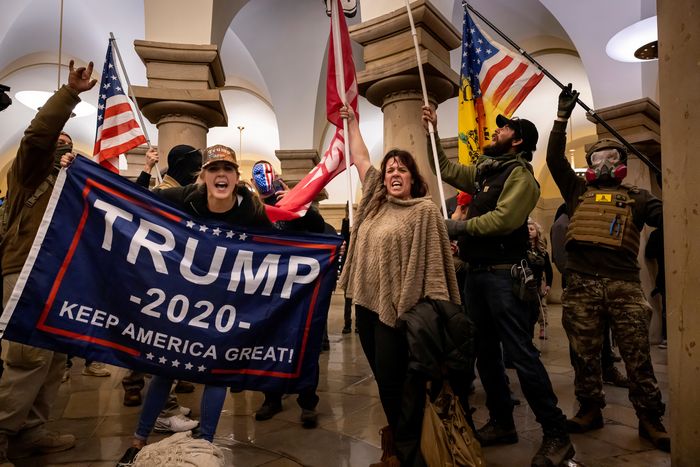
Trump supporters protest inside the U.S. Capitol after breeching security in Washington, Jan. 6, 2021.PHOTO: BRENT STIRTON/GETTY IMAGES
I rose early that day and worked on my statement to Congress. When the phone rang a little after 11 a.m., it was the president. “Despite the press release you issued last night,” I said, “I have always been forthright with you, Mr. President.” I reiterated that I didn’t believe I had the power to decide which electoral votes would count and said I would be issuing a statement to Congress confirming that before the joint session started.
The president laid into me. “You’ll go down as a wimp,” he said. “If you do that, I made a big mistake five years ago!”
But when he said, “You’re not protecting our country, you’re supposed to support and defend our country!” I calmly reminded him, “We both took an oath to support and defend the Constitution.”
As I headed to the Capitol, President Trump took the stage. He told the crowd: “I hope Mike is going to do the right thing. I hope so. I hope so. Because if Mike Pence does the right thing, we win the election.” Repeating the argument made by the crank lawyers standing just offstage, he said, “All he has to do, all this is, this is from the No. 1, or certainly one of the top, constitutional lawyers in our country. . . . All Vice President Pence has to do is send it back to the states to recertify and we become president and you are the happiest people.”
As our motorcade arrived at the Capitol, I saw thousands of protesters standing peacefully on the East Lawn. I felt compassion for all the good people who had traveled to Washington having been told that the outcome of the election could be changed. They cheered as we entered. I turned to my daughter and sighed: “God bless those people. They’re gonna be so disappointed.”
I had no idea that what was later described as a “wall of people” had formed about a block west of the Capitol. As I led senators onto the House floor, the mood was solemn. There was no indication of the mayhem unfolding outside. Speaker Nancy Pelosi gaveled the chamber into session a little after 1 p.m.
When the electoral votes for Arizona were opened, Rep. Paul Gosar rose to raise the first objection of the day, co-sponsored by 60 representatives. When I asked if the motion had a Senate sponsor, Ted Cruz rose. I adjourned the joint session and accompanied senators back to their chamber, still oblivious to the riot outside.
Forty minutes into the session, Republican James Lankford of Oklahoma had the floor when the Senate parliamentarian, Elizabeth MacDonough, seated a few feet in front of me, leaned back in her chair and whispered: “Mr. Vice President, protesters have breached the building’s doors on the first floor. Just informing you.”
A member of my Secret Service detail walked onto the Senate floor, straight to my chair, and said, “Mr. Vice President, we gotta go.” I was confident that the U.S. Capitol Police would soon have the situation in hand, so I told him we’d wait in the nearby ceremonial office reserved for my use as president of the Senate.
Soon my lead Secret Service agent, Timothy Giebels, walked into that crowded office and said, “Sir, we’ve got to get you out of the building.” The protesters who had smashed their way into the House side of the Capitol were heading for the Senate. I later learned that many had come looking for me.
I told my detail that I wasn’t leaving my post. Mr. Giebels pleaded for us to leave. The rioters had reached our floor. I pointed my finger at his chest and said, “You’re not hearing me, I’m not leaving! I’m not giving those people the sight of a 16-car motorcade speeding away from the Capitol.”
“OK,” he answered in a voice that made it clear that it wasn’t. “Well, we can’t stay here. This office only has a glass door, and we can’t protect you.”
My daughter Charlotte, sensing my frustration, asked, “Isn’t there somewhere else dad can go that is still in the Capitol?” Mr. Giebels said we could move to the loading dock and garage, a few stories below. I agreed.
The steps were secured. We walked out into the hall slowly. All around us was a blur of motion and chaos: security and police officers directing people to safety, staffers shouting and running for shelter. I heard footsteps and angry chanting. Making our way to the basement of the Capitol took a few extra minutes because I insisted that we walk, not run. The Secret Service team grudgingly accommodated me.
Arriving in the loading dock, we saw that our motorcade had been repositioned, with all the cars pointed toward a ramp leading out. Mr. Giebels began to escort us toward our cars. I stopped and said, “I’m not getting in the car.”
“Sir,” he replied, “we’re just going to have you wait in the car, but we are not leaving the Capitol.”
“Tim, I believe you,” I said. “You’re a man of integrity, but you’re not driving that car.” I knew that if we got into the car, somebody would tell the driver to get us out of the building.
We had no television in the garage, so my staff and security team briefed me on the situation using police radio communications and Twitter. The House and Senate leaders had been whisked away to a secure location off Capitol Hill, but other members were barricaded in the House chamber as Capitol Police worked to hold back the mob.
My unflappable assistant Zach Bauer walked up sheepishly and handed me his phone. The president had sent a tweet at 2:24 p.m.: “Mike Pence didn’t have the courage to do what should have been done to protect our Country and our Constitution, giving States a chance to certify a corrected set of facts, not the fraudulent or inaccurate ones which they were asked to previously certify. USA demands the truth!”
Rioters were ransacking the Capitol. Some of them, I was later told, were chanting, “Hang Mike Pence!” I ignored the tweet and got back to work.
My chief of staff arranged for a conference call with the congressional leadership. Senate Minority Leader Mitch McConnell made the point that it was imperative Congress reconvene as soon as possible to complete the vote count. Everyone agreed.
By 2:38 p.m., it appeared that cooler heads had prevailed at the White House. The president tweeted, “Please support our Capitol Police and Law Enforcement. They are truly on the side of our Country. Stay peaceful!” A half hour later, he urged the rioters to “remain peaceful. No violence! Remember, WE are the Party of Law & Order—respect the Law and our great men and women in Blue.” At 4:17 p.m., the president issued a video telling the rioters, “I know your pain, I know your hurt . . . but you have to go home now, we have to have peace.”
By 7 p.m., we had been cleared to return to my office. When the session reconvened, everything changed. Many lawmakers withdrew support for objections that had been properly filed. Beyond the violence and destruction, the Jan. 6 rioters had managed to end the debate over election irregularities. At around 3:40 a.m., Sen. Amy Klobuchar of Minnesota read the results of the 2020 election.
I met with the president on Jan. 11. He looked tired, and his voice seemed fainter than usual. “How are you?” he began. “How are Karen and Charlotte?” I replied tersely that we were fine and told him that they had been at the Capitol on Jan. 6. He responded with a hint of regret, “I just learned that.” He then asked, “Were you scared?”
“No,” I replied, “I was angry. You and I had our differences that day, Mr. President, and seeing those people tearing up the Capitol infuriated me.”
He started to bring up the election, saying that people were angry, but his voice trailed off.
I told him he had to set that aside, and he responded quietly, “Yeah.”
I said, “Those people who broke into the Capitol might’ve been supporters, but they are not our movement.” For five years, we had both spoken to crowds of the most patriotic, law-abiding, God-fearing people in the country.
With genuine sadness in his voice, the president mused: “What if we hadn’t had the rally? What if they hadn’t gone to the Capitol?” Then he said, “It’s too terrible to end like this.”
On Jan. 14, the day after President Trump was impeached for the second time, I stopped by the Oval Office. The night before, he had unequivocally denounced the violence at the Capitol and called for calm and national unity. I congratulated him on his address. “I knew you’d like it,” he said. He seemed discouraged, so I reminded him that I was praying for him.
“Don’t bother,” he said.
As I stood to leave, he said, “It’s been fun.”
“A privilege, Mr. President,” I answered.
“Yeah, with you.”
Walking toward the door leading to the hallway, I paused, looked the president in the eye, and said, “I guess we will just have to disagree on two things.”
“What?”
I referred to our disagreement about Jan. 6 and then said, “I’m also never gonna stop praying for you.”
He smiled: “That’s right—don’t ever change.”
y Last Days With Donald Trump
I supported legitimate challenges to the 2020 vote counts. I also recognized that the Constitution didn’t give me authority to override the voters—and I followed my conscience on Jan. 6.
October 24, 2022 at 04:31PM. Biden Regime Set to Warn About “Threats to Nation’s Election Infrastructure” Ahead of Midterms, including China, Russia and Non-State Actors
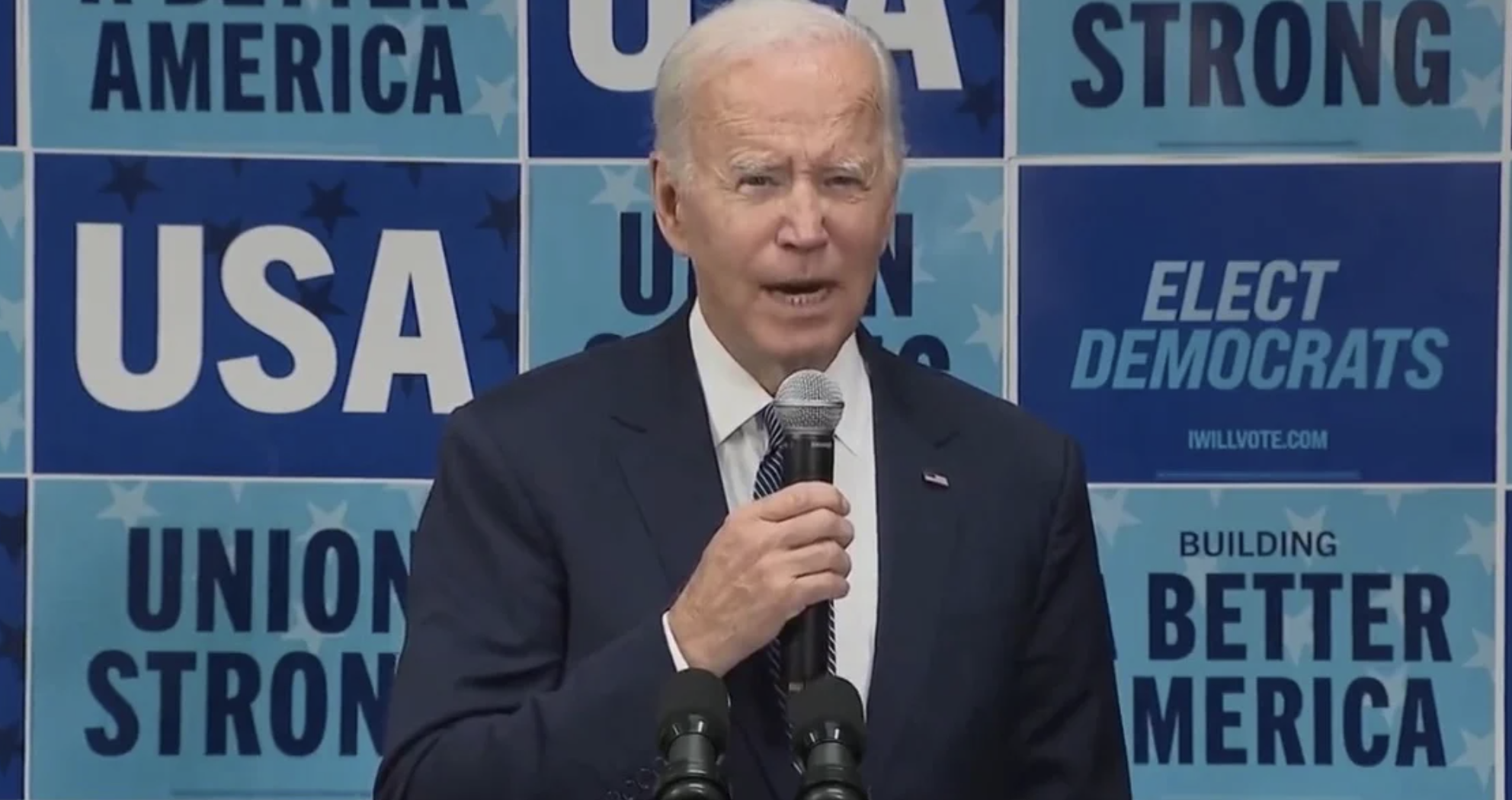
JUST IN – Biden admin set to warn about “threats to nation’s election infrastructure” ahead of midterms — an intelligence bulletin is slated to be issued this week, Politico reports.
The Biden regime is set to warn Americans about the “threats to the nation’s election infrastructure” later this week ahead of the 2022 midterm elections.
The intelligence bulletin will lay out details of cyber threats posed by China, Russia, other non-state actors, and potential physical threats to election officials in jurisdictions across the country.
The FBI-DOJ is hoping they can move the needle a bit to assist the Democrat-Socialists who have managed to destroy the economy, the border, and US foreign policy in less than two years.
Top Biden national security officials are tracking multiple threats to the nation’s election security infrastructure ahead of the midterms and are set to issue warnings, including in an internal intelligence bulletin this week, according to two people familiar with the matter.
The bulletin will lay out details of cyber threats posed by China and Russia, as well as other non-state actors, and potential physical threats to election officials in jurisdictions across the country, the people said. The warnings come as the midterm elections near and amid increasing reports of intimidation at ballot drop boxes. The people requested anonymity to talk freely about sensitive national security and election matters.
The Department of Justice is set to address several malign influence schemes and alleged criminal activity by non-state actors in a press conference Monday. It’s unclear if its announcement and the intelligence bulletin warnings are connected.
Furthermore, Biden’s ‘American Rescue Plan’ provided $350 billion to respond to the Covid pandemic and he is still asking for more money.
VIDEO:
Biden made a similar statement in June of this year.
Biden said we need more money because there is going to be another pandemic.
“We need more money. We don’t just need more money for vaccines for children, we need more money to plan for the second pandemic. There’s gonna be another pandemic,” said Biden in June.
Kari Donovan is “developing this article” with Pete Santilli
Americans know that a viperous threat to American civil liberty unfolds as journalists collude with government agencies over stories instead of journalists being ‘watchmen on the walls’ and monitoring the actions of the government to help serve the American people with independent information.
And at this point in American history, we are at a crossroads regarding the role of news media in our society because the pressure to promote the ‘government line’ is great, considering the massive blow back to Alex Jones, and few brave journalists will now willing to tell the truth.
For example, after generations of speculations and rumors about the involvement of the CIA and other Government security agencies on news journalists, we have proof that the American press has not been liberated to tell the truth.
With the use of technological tools available online for free, like the Wayback Machine, and in current headlines of brave outlets, we can now prove that Media-government intimidation is a pattern that threatens the free flow of information.
Numerous headlines are currently showing the impact of government collusion in the story about Missouri V. Biden, and in the story about the FBI suppressing the Hunter Biden laptop story.
Pete Santilli has exposed the suspicious pattern of intimidation of a top journalist in this following story, which likely proves that the degree of censorship of information during the past few years has reached stunning levels.
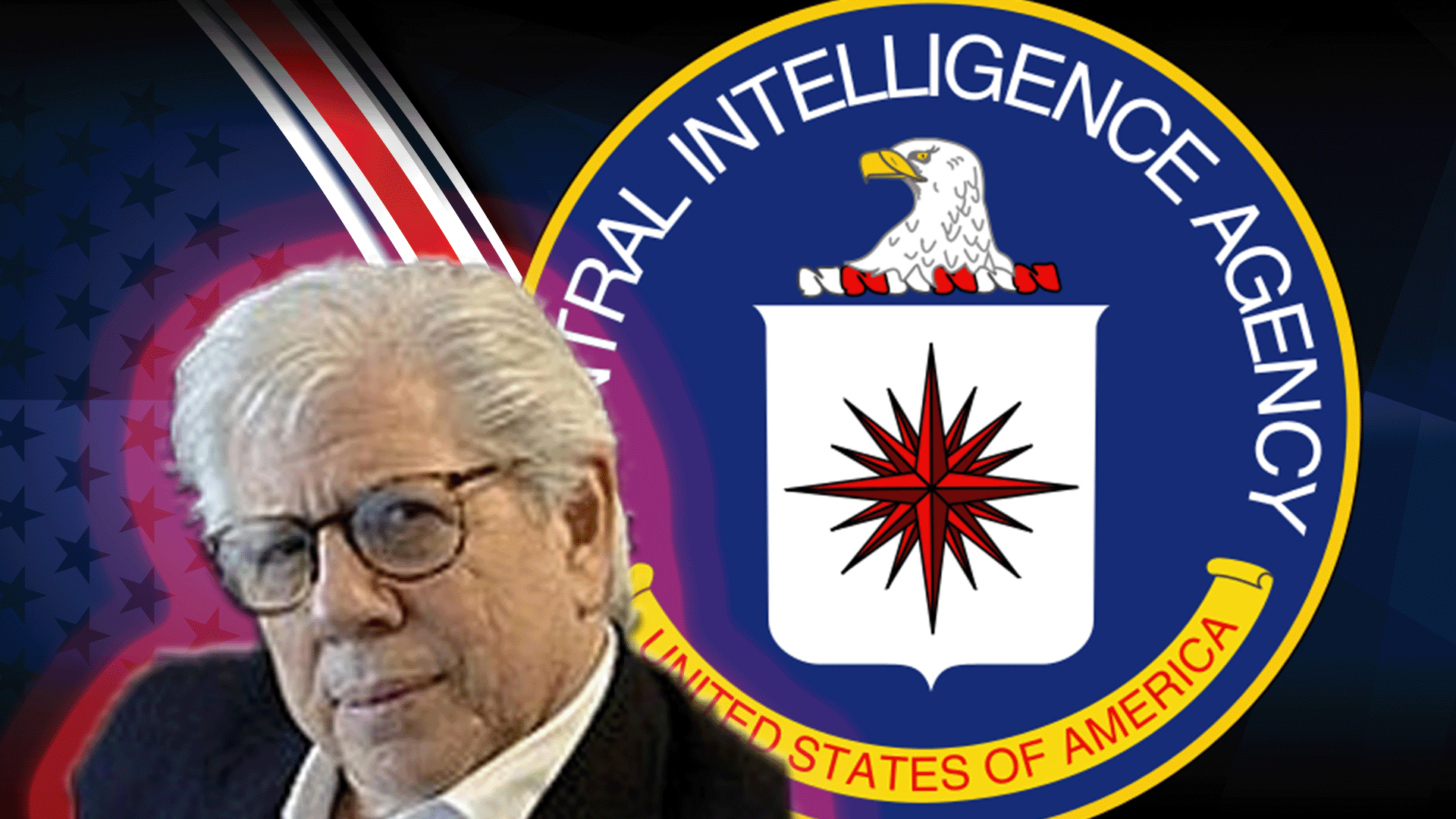
Santilli started out his research with a well-trafficked article about the conclusion of the CIA upon media by the Pulitzer Prize-winning journalist Carl Bernstein which had been taken down, moved around, and then mysteriously reposted just recently.
Santilli is still investigating to find out what happened to a highly important article he found linked to a huge site that was taken down and hidden from the public and then quietly reposted somewhere else.
Here is the original article on Robert Kennedy Jr.’s site, where Santilli found the Bernstein link:
Robert F. Kennedy’s Website (Linking to Carl Bernstein) – Published Dec 2021
When he clicked the link, he found it was dead and the article he was searching for was gone:
Santilli then searched for the article on the Wayback Machine and found that, according to the patterns, the article had gotten a large amount of traffic:
Santilli discovered that the article had been moved, and the article was suspiciously republished on October 22, 2022, and Santilli discussed on his recent program some speculation as to why it was reposted in the manner it was:
Santilli, attempting to get some clarifying information, sent Carl Bernstein an email inquiring why it was removed & then republished and has yet to hear back:
How Americas Most Powerful News Media Worked Hand in Glove with the Central Intelligence Agency and Why the Church Committee Covered It Up
[REPUBLISHED BY] PETE SANTILLI, Founder of the “Citizen’s Intelligence Agency” (CIA) & Host of The Pete Santilli Show
In 1953, Joseph Alsop, then one of America’s leading syndicated columnists, went to the Philippines to cover an election. He did not go because he was asked to do so by his syndicate. He did not go because he was asked to do so by the newspapers that printed his column. He went at the request of the CIA.
Alsop is one of more than 400 American journalists who in the past twenty‑five years have secretly carried out assignments for the Central Intelligence Agency, according to documents on file at CIA headquarters. Some of these journalists’ relationships with the Agency were tacit; some were explicit. There was cooperation, accommodation and overlap. Journalists provided a full range of clandestine services—from simple intelligence gathering to serving as go‑betweens with spies in Communist countries. Reporters shared their notebooks with the CIA. Editors shared their staffs. Some of the journalists were Pulitzer Prize winners, distinguished reporters who considered themselves ambassadors without‑portfolio for their country. Most were less exalted: foreign correspondents who found that their association with the Agency helped their work; stringers and freelancers who were as interested in the derring‑do of the spy business as in filing articles; and, the smallest category, full‑time CIA employees masquerading as journalists abroad. In many instances, CIA documents show, journalists were engaged to perform tasks for the CIA with the consent of the managements of America’s leading news organizations.
The history of the CIA’s involvement with the American press continues to be shrouded by an official policy of obfuscation and deception for the following principal reasons:
■ The use of journalists has been among the most productive means of intelligence‑gathering employed by the CIA. Although the Agency has cut back sharply on the use of reporters since 1973 primarily as a result of pressure from the media), some journalist‑operatives are still posted abroad.
■ Further investigation into the matter, CIA officials say, would inevitably reveal a series of embarrassing relationships in the 1950s and 1960s with some of the most powerful organizations and individuals in American journalism.
Among the executives who lent their cooperation to the Agency were Williarn Paley of the Columbia Broadcasting System, Henry Luce of Tirne Inc., Arthur Hays Sulzberger of the New York Times, Barry Bingham Sr. of the LouisviIle Courier‑Journal, and James Copley of the Copley News Service. Other organizations which cooperated with the CIA include the American Broadcasting Company, the National Broadcasting Company, the Associated Press, United Press International, Reuters, Hearst Newspapers, Scripps‑Howard, Newsweek magazine, the Mutual Broadcasting System, the Miami Herald and the old Saturday Evening Post and New York Herald‑Tribune.
By far the most valuable of these associations, according to CIA officials, have been with the New York Times, CBS and Time Inc.
The CIA’s use of the American news media has been much more extensive than Agency officials have acknowledged publicly or in closed sessions with members of Congress. The general outlines of what happened are indisputable; the specifics are harder to come by. CIA sources hint that a particular journalist was trafficking all over Eastern Europe for the Agency; the journalist says no, he just had lunch with the station chief. CIA sources say flatly that a well‑known ABC correspondent worked for the Agency through 1973; they refuse to identify him. A high‑level CIA official with a prodigious memory says that the New York Times provided cover for about ten CIA operatives between 1950 and 1966; he does not know who they were, or who in the newspaper’s management made the arrangements.
The Agency’s special relationships with the so‑called “majors” in publishing and broadcasting enabled the CIA to post some of its most valuable operatives abroad without exposure for more than two decades. In most instances, Agency files show, officials at the highest levels of the CIA usually director or deputy director) dealt personally with a single designated individual in the top management of the cooperating news organization. The aid furnished often took two forms: providing jobs and credentials “journalistic cover” in Agency parlance) for CIA operatives about to be posted in foreign capitals; and lending the Agency the undercover services of reporters already on staff, including some of the best‑known correspondents in the business.
In the field, journalists were used to help recruit and handle foreigners as agents; to acquire and evaluate information, and to plant false information with officials of foreign governments. Many signed secrecy agreements, pledging never to divulge anything about their dealings with the Agency; some signed employment contracts., some were assigned case officers and treated with. unusual deference. Others had less structured relationships with the Agency, even though they performed similar tasks: they were briefed by CIA personnel before trips abroad, debriefed afterward, and used as intermediaries with foreign agents. Appropriately, the CIA uses the term “reporting” to describe much of what cooperating journalists did for the Agency. “We would ask them, ‘Will you do us a favor?’”.said a senior CIA official. “‘We understand you’re going to be in Yugoslavia. Have they paved all the streets? Where did you see planes? Were there any signs of military presence? How many Soviets did you see? If you happen to meet a Soviet, get his name and spell it right …. Can you set up a meeting for is? Or relay a message?’” Many CIA officials regarded these helpful journalists as operatives; the journalists tended to see themselves as trusted friends of the Agency who performed occasional favors—usually without pay—in the national interest.
“I’m proud they asked me and proud to have done it,” said Joseph Alsop who, like his late brother, columnist Stewart Alsop, undertook clandestine tasks for the Agency. “The notion that a newspaperman doesn’t have a duty to his country is perfect balls.”
From the Agency’s perspective, there is nothing untoward in such relationships, and any ethical questions are a matter for the journalistic profession to resolve, not the intelligence community. As Stuart Loory, former Los Angeles Times correspondent, has written in the ColumbiaJournalism Review: ‘If even one American overseas carrying a press card is a paid informer for the CIA, then all Americans with those credentials are suspect …. If the crisis of confidence faced by the news business—along with the government—is to be overcome, journalists must be willing to focus on themselves the same spotlight they so relentlessly train on others!’ But as Loory also noted: “When it was reported… that newsmen themselves were on the payroll of the CIA, the story caused a brief stir, and then was dropped.”
During the 1976 investigation of the CIA by the Senate Intelligence Committee, chaired by Senator Frank Church, the dimensions of the Agency’s involvement with the press became apparent to several members of the panel, as well as to two or three investigators on the staff. But top officials of the CIA, including former directors William Colby and George Bush, persuaded the committee to restrict its inquiry into the matter and to deliberately misrepresent the actual scope of the activities in its final report. The multivolurne report contains nine pages in which the use of journalists is discussed in deliberately vague and sometimes misleading terms. It makes no mention of the actual number of journalists who undertook covert tasks for the CIA. Nor does it adequately describe the role played by newspaper and broadcast executives in cooperating with the Agency.
THE AGENCY’S DEALINGS WITH THE PRESS BEGAN during the earliest stages of the Cold War. Allen Dulles, who became director of the CIA in 1953, sought to establish a recruiting‑and‑cover capability within America’s most prestigious journalistic institutions. By operating under the guise of accredited news correspondents, Dulles believed, CIA operatives abroad would be accorded a degree of access and freedom of movement unobtainable under almost any other type of cover.
American publishers, like so many other corporate and institutional leaders at the time, were willing to commit the resources of their companies to the struggle against “global Communism.” Accordingly, the traditional line separating the American press corps and government was often indistinguishable: rarely was a news agency used to provide cover for CIA operatives abroad without the knowledge and consent of either its principal owner, publisher or senior editor. Thus, contrary to the notion that the CIA insidiously infiltrated the journalistic community, there is ample evidence that America’s leading publishers and news executives allowed themselves and their organizations to become handmaidens to the intelligence services. “Let’s not pick on some poor reporters, for God’s sake,” William Colby exclaimed at one point to the Church committee’s investigators. “Let’s go to the managements. They were witting.” In all, about twenty‑five news organizations including those listed at the beginning of this article) provided cover for the Agency.
In addition to cover capability, Dulles initiated a “debriefing” procedure under which American correspondents returning from abroad routinely emptied their notebooks and offered their impressions to Agency personnel. Such arrangements, continued by Dulles’ successors, to the present day, were made with literally dozens of news organizations. In the 1950s, it was not uncommon for returning reporters to be met at the ship by CIA officers. “There would be these guys from the CIA flashing ID cards and looking like they belonged at the Yale Club,” said Hugh Morrow, a former Saturday Evening Post correspondent who is now press secretary to former vice‑president Nelson Rockefeller. “It got to be so routine that you felt a little miffed if you weren’t asked.”
CIA officials almost always refuse to divulge the names of journalists who have cooperated with the Agency. They say it would be unfair to judge these individuals in a context different from the one that spawned the relationships in the first place. “There was a time when it wasn’t considered a crime to serve your government,” said one high‑level CIA official who makes no secret of his bitterness. “This all has to be considered in the context of the morality of the times, rather than against latter‑day standards—and hypocritical standards at that.”
Many journalists who covered World War II were close to people in the Office of Strategic Services, the wartime predecessor of the CIA; more important, they were all on the same side. When the war ended and many OSS officials went into the CIA, it was only natural that these relationships would continue. Meanwhile, the first postwar generation of journalists entered the profession; they shared the same political and professional values as their mentors. “You had a gang of people who worked together during World War II and never got over it,” said one Agency official. “They were genuinely motivated and highly susceptible to intrigue and being on the inside. Then in the Fifties and Sixties there was a national consensus about a national threat. The Vietnam War tore everything to pieces—shredded the consensus and threw it in the air.” Another Agency official observed: “Many journalists didn’t give a second thought to associating with the Agency. But there was a point when the ethical issues which most people had submerged finally surfaced. Today, a lot of these guys vehemently deny that they had any relationship with the Agency.”
From the outset, the use of journalists was among the CIA’s most sensitive undertakings, with full knowledge restricted to the Director of Central Intelligence and a few of his chosen deputies. Dulles and his successors were fearful of what would happen if a journalist‑operative’s cover was blown, or if details of the Agency’s dealings with the press otherwise became public. As a result, contacts with the heads of news organizations were normally initiated by Dulles and succeeding Directors of Central Intelligence; by the deputy directors and division chiefs in charge of covert operations—Frank Wisner, Cord Meyer Jr., Richard Bissell, Desmond FitzGerald, Tracy Barnes, Thomas Karamessines and Richard Helms himself a former UPI correspondent); and, occasionally, by others in the CIA hierarchy known to have an unusually close social relationship with a particular publisher or broadcast executive.1
James Angleton, who was recently removed as the Agency’s head of counterintelligence operations, ran a completely independent group of journalist‑operatives who performed sensitive and frequently dangerous assignments; little is known about this group for the simple reason that Angleton deliberately kept only the vaguest of files.
The CIA even ran a formal training program in the 1950s to teach its agents to be journalists. Intelligence officers were “taught to make noises like reporters,” explained a high CIA official, and were then placed in major news organizations with help from management. “These were the guys who went through the ranks and were told ‘You’re going to he a journalist,’” the CIA official said. Relatively few of the 400‑some relationships described in Agency files followed that pattern, however; most involved persons who were already bona fide journalists when they began undertaking tasks for the Agency.
The Agency’s relationships with journalists, as described in CIA files, include the following general categories:
■ Legitimate, accredited staff members of news organizations—usually reporters. Some were paid; some worked for the Agency on a purely voluntary basis. This group includes many of the best‑known journalists who carried out tasks for the CIA. The files show that the salaries paid to reporters by newspaper and broadcast networks were sometimes supplemented by nominal payments from the CIA, either in the form of retainers, travel expenses or outlays for specific services performed. Almost all the payments were made in cash. The accredited category also includes photographers, administrative personnel of foreign news bureaus and members of broadcast technical crews.)
Two of the Agency’s most valuable personal relationships in the 1960s, according to CIA officials, were with reporters who covered Latin America—Jerry O’Leary of the Washington Star and Hal Hendrix of the Miami News, a Pulitzer Prize winner who became a high official of the International Telephone and Telegraph Corporation. Hendrix was extremely helpful to the Agency in providing information about individuals in Miami’s Cuban exile community. O’Leary was considered a valued asset in Haiti and the Dominican Republic. Agency files contain lengthy reports of both men’s activities on behalf of the CIA.
O’Leary maintains that his dealings were limited to the normal give‑and‑take that goes on between reporters abroad and their sources. CIA officials dispute the contention: “There’s no question Jerry reported for us,” said one. “Jerry did assessing and spotting [of prospective agents] but he was better as a reporter for us.” Referring to O’Leary’s denials, the official added: “I don’t know what in the world he’s worried about unless he’s wearing that mantle of integrity the Senate put on you journalists.”
O’Leary attributes the difference of opinion to semantics. “I might call them up and say something like, ‘Papa Doc has the clap, did you know that?’ and they’d put it in the file. I don’t consider that reporting for them…. it’s useful to be friendly to them and, generally, I felt friendly to them. But I think they were more helpful to me than I was to them.” O’Leary took particular exception to being described in the same context as Hendrix. “Hal was really doing work for them,” said O’Leary. “I’m still with the Star. He ended up at ITT.” Hendrix could not be reached for comment. According to Agency officials, neither Hendrix nor O’Leary was paid by the CIA.
■ Stringers2 and freelancers. Most were payrolled by the Agency under standard contractual terms. Their journalistic credentials were often supplied by cooperating news organizations. some filed news stories; others reported only for the CIA. On some occasions, news organizations were not informed by the CIA that their stringers were also working for the Agency.
■ Employees of so‑called CIA “proprietaries.” During the past twenty‑five years, the Agency has secretly bankrolled numerous foreign press services, periodicals and newspapers—both English and foreign language—which provided excellent cover for CIA operatives. One such publication was the Rome Daily American, forty percent of which was owned by the CIA until the 1970s. The Daily American went out of business this year,
■ Editors, publishers and broadcast network executives. The CIAs relationship with most news executives differed fundamentally from those with working reporters and stringers, who were much more subject to direction from the Agency. A few executives—Arthur Hays Sulzberger of the New York Times among them—signed secrecy agreements. But such formal understandings were rare: relationships between Agency officials and media executives were usually social—”The P and Q Street axis in Georgetown,” said one source. “You don’t tell Wilharn Paley to sign a piece of paper saying he won’t fink.”
■ Columnists and commentators. There are perhaps a dozen well known columnists and broadcast commentators whose relationships with the CIA go far beyond those normally maintained between reporters and their sources. They are referred to at the Agency as “known assets” and can be counted on to perform a variety of undercover tasks; they are considered receptive to the Agency’s point of view on various subjects. Three of the most widely read columnists who maintained such ties with the Agency are C.L. Sulzberger of the New York Times, Joseph Alsop, and the late Stewart Alsop, whose column appeared in the New York Herald‑Tribune, the Saturday Evening Post and Newsweek. CIA files contain reports of specific tasks all three undertook. Sulzberger is still regarded as an active asset by the Agency. According to a senior CIA official, “Young Cy Sulzberger had some uses…. He signed a secrecy agreement because we gave him classified information…. There was sharing, give and take. We’d say, ‘Wed like to know this; if we tell you this will it help you get access to so‑and‑so?’ Because of his access in Europe he had an Open Sesame. We’d ask him to just report: ‘What did so‑and‑so say, what did he look like, is he healthy?’ He was very eager, he loved to cooperate.” On one occasion, according to several CIA officials, Sulzberger was given a briefing paper by the Agency which ran almost verbatim under the columnist’s byline in the Times. “Cycame out and said, ‘I’m thinking of doing a piece, can you give me some background?’” a CIA officer said. “We gave it to Cy as a background piece and Cy gave it to the printers and put his name on it.” Sulzberger denies that any incident occurred. “A lot of baloney,” he said.
Sulzberger claims that he was never formally “tasked” by the Agency and that he “would never get caught near the spook business. My relations were totally informal—I had a goodmany friends,” he said. “I’m sure they consider me an asset. They can ask me questions. They find out you’re going to Slobovia and they say, ‘Can we talk to you when you get back?’ … Or they’ll want to know if the head of the Ruritanian government is suffering from psoriasis. But I never took an assignment from one of those guys…. I’ve known Wisner well, and Helms and even McCone [former CIA director John McCone] I used to play golf with. But they’d have had to he awfully subtle to have used me.
Sulzberger says he was asked to sign the secrecy agreement in the 1950s. “A guy came around and said, ‘You are a responsible newsman and we need you to sign this if we are going to show you anything classified.’ I said I didn’t want to get entangled and told them, ‘Go to my uncle [Arthur Hays Sulzberger, then publisher of the New York Times] and if he says to sign it I will.’” His uncle subsequently signed such an agreement, Sulzberger said, and he thinks he did too, though he is unsure. “I don’t know, twenty‑some years is a long time.” He described the whole question as “a bubble in a bathtub.”
Stewart Alsop’s relationship with the Agency was much more extensive than Sulzberger’s. One official who served at the highest levels in the CIA said flatly: “Stew Alsop was a CIA agent.” An equally senior official refused to define Alsop’s relationship with the Agency except to say it was a formal one. Other sources said that Alsop was particularly helpful to the Agency in discussions with, officials of foreign governments—asking questions to which the CIA was seeking answers, planting misinformation advantageous to American policy, assessing opportunities for CIA recruitment of well‑placed foreigners.
“Absolute nonsense,” said Joseph Alsop of the notion that his brother was a CIA agent. “I was closer to the Agency than Stew was, though Stew was very close. I dare say he did perform some tasks—he just did the correct thing as an American…. The Founding Fathers [of the CIA] were close personal friends of ours. Dick Bissell [former CIA deputy director] was my oldest friend, from childhood. It was a social thing, my dear fellow. I never received a dollar, I never signed a secrecy agreement. I didn’t have to…. I’ve done things for them when I thought they were the right thing to do. I call it doing my duty as a citizen.
Alsop is willing to discuss on the record only two of the tasks he undertook: a visit to Laos in 1952 at the behest of Frank Wisner, who felt other American reporters were using anti‑American sources about uprisings there; and a visit to the Phillipines in 1953 when the CIA thought his presence there might affect the outcome of an election. “Des FitzGerald urged me to go,” Alsop recalled. “It would be less likely that the election could be stolen [by the opponents of Ramon Magsaysay] if the eyes of the world were on them. I stayed with the ambassador and wrote about what happened.”
Alsop maintains that he was never manipulated by the Agency. “You can’t get entangled so they have leverage on you,” he said. “But what I wrote was true. My view was to get the facts. If someone in the Agency was wrong, I stopped talking to them—they’d given me phony goods.” On one occasion, Alsop said, Richard Helms authorized the head of the Agency’s analytical branch to provide Alsop with information on Soviet military presence along the Chinese border. “The analytical side of the Agency had been dead wrong about the war in Vietnam—they thought it couldn’t be won,” said Alsop. “And they were wrong on the Soviet buildup. I stopped talking to them.” Today, he says, “People in our business would be outraged at the kinds of suggestions that were made to me. They shouldn’t be. The CIA did not open itself at all to people it did not trust. Stew and I were trusted, and I’m proud of it.”
MURKY DETAILS OF CIA RELATIONSHIPS WITH INDIVIDUALS and news organizations began trickling out in 1973 when it was first disclosed that the CIA had, on occasion, employed journalists. Those reports, combined with new information, serve as casebook studies of the Agency’s use of journalists for intelligence purposes. They include:
■ The New York Times. The Agency’s relationship with the Times was by far its most valuable among newspapers, according to CIA officials. From 1950 to 1966, about ten CIA employees were provided Times cover under arrangements approved by the newspaper’s late publisher, Arthur Hays Sulzberger. The cover arrangements were part of a general Times policy—set by Sulzberger—to provide assistance to the CIA whenever possible.
Sulzberger was especially close to Allen Dulles. “At that level of contact it was the mighty talking to the mighty,” said a high‑level CIA official who was present at some of the discussions. “There was an agreement in principle that, yes indeed, we would help each other. The question of cover came up on several occasions. It was agreed that the actual arrangements would be handled by subordinates…. The mighty didn’t want to know the specifics; they wanted plausible deniability.
A senior CIA official who reviewed a portion of the Agency’s files on journalists for two hours onSeptember 15th, 1977, said he found documentation of five instances in which the Times had provided cover for CIA employees between 1954 and 1962. In each instance he said, the arrangements were handled by executives of the Times; the documents all contained standard Agency language “showing that this had been checked out at higher levels of the New York Times,” said the official. The documents did not mention Sulzberger’s name, however—only those of subordinates whom the official refused to identify.
The CIA employees who received Times credentials posed as stringers for the paper abroad and worked as members of clerical staffs in the Times’ foreign bureaus. Most were American; two or three were foreigners.
CIA officials cite two reasons why the Agency’s working relationship with the Times was closer and more extensive than with any other paper: the fact that the Times maintained the largest foreign news operation in American daily journalism; and the close personal ties between the men who ran both institutions.
Sulzberger informed a number of reporters and editors of his general policy of cooperation with the Agency. “We were in touch with them—they’d talk to us and some cooperated,” said a CIA official. The cooperation usually involved passing on information and “spotting” prospective agents among foreigners.
Arthur Hays Sulzberger signed a secrecy agreement with the CIA in the 1950s, according to CIA officials—a fact confirmed by his nephew, C.L. Sulzberger. However, there are varying interpretations of the purpose of the agreement: C.L. Sulzberger says it represented nothing more than a pledge not to disclose classified information made available to the publisher. That contention is supported by some Agency officials. Others in the Agency maintain that the agreement represented a pledge never to reveal any of the Times’ dealings with the CIA, especially those involving cover. And there are those who note that, because all cover arrangements are classified, a secrecy agreement would automatically apply to them.
Attempts to find out which individuals in the Times organization made the actual arrangements for providing credentials to CIA personnel have been unsuccessful. In a letter to reporter Stuart Loory in 1974, Turner Cadedge, managing editor of the Times from 1951 to 1964, wrote that approaches by the CIA had been rebuffed by the newspaper. “I knew nothing about any involvement with the CIA… of any of our foreign correspondents on the New York Times. I heard many times of overtures to our men by the CIA, seeking to use their privileges, contacts, immunities and, shall we say, superior intelligence in the sordid business of spying and informing. If any one of them succumbed to the blandishments or cash offers, I was not aware of it. Repeatedly, the CIA and other hush‑hush agencies sought to make arrangements for ‘cooperation’ even with Times management, especially during or soon after World War II, but we always resisted. Our motive was to protect our credibility.”
According to Wayne Phillips, a former Timesreporter, the CIA invoked Arthur Hays Sulzberger’s name when it tried to recruit him as an undercover operative in 1952 while he was studying at Columbia University’s Russian Institute. Phillips said an Agency official told him that the CIA had “a working arrangement” with the publisher in which other reporters abroad had been placed on the Agency’s payroll. Phillips, who remained at the Times until 1961, later obtained CIA documents under the Freedom of Information Act which show that the Agency intended to develop him as a clandestine “asset” for use abroad.
On January 31st, 1976, the Times carried a brief story describing the ClAs attempt to recruit Phillips. It quoted Arthur Ochs Sulzberger, the present publisher, as follows: “I never heard of the Times being approached, either in my capacity as publisher or as the son of the late Mr. Sulzberger.” The Times story, written by John M. Crewdson, also reported that Arthur Hays Sulzberger told an unnamed former correspondent that he might he approached by the CIA after arriving at a new post abroad. Sulzberger told him that he was not “under any obligation to agree,” the story said and that the publisher himself would be “happier” if he refused to cooperate. “But he left it sort of up to me,” the Times quoted its former reporter as saying. “The message was if I really wanted to do that, okay, but he didn’t think it appropriate for a Times correspondent”
C.L. Sulzberger, in a telephone interview, said he had no knowledge of any CIA personnel using Times cover or of reporters for the paper working actively for the Agency. He was the paper’s chief of foreign service from 1944 to 1954 and expressed doubt that his uncle would have approved such arrangements. More typical of the late publisher, said Sulzberger, was a promise made to Allen Dulles’ brother, John Foster, then secretary of state, that no Times staff member would be permitted to accept an invitation to visit the People’s Republic of China without John Foster Dulles’ consent. Such an invitation was extended to the publisher’s nephew in the 1950s; Arthur Sulzberger forbade him to accept it. “It was seventeen years before another Times correspondent was invited,” C.L. Sulzberger recalled.
■ The Columbia Broadcasting System. CBS was unquestionably the CIAs most valuable broadcasting asset. CBS President William Paley and Allen Dulles enjoyed an easy working and social relationship. Over the years, the network provided cover for CIA employees, including at least one well‑known foreign correspondent and several stringers; it supplied outtakes of newsfilm to the CIA3; established a formal channel of communication between the Washington bureau chief and the Agency; gave the Agency access to the CBS newsfilm library; and allowed reports by CBS correspondents to the Washington and New York newsrooms to be routinely monitored by the CIA. Once a year during the 1950s and early 1960s, CBS correspondents joined the CIA hierarchy for private dinners and briefings.
The details of the CBS‑CIA arrangements were worked out by subordinates of both Dulles and Paley. “The head of the company doesn’t want to know the fine points, nor does the director,” said a CIA official. “Both designate aides to work that out. It keeps them above the battle.” Dr. Frank Stanton, for 25 years president of the network, was aware of the general arrangements Paley made with Dulles—including those for cover, according to CIA officials. Stanton, in an interview last year, said he could not recall any cover arrangements.) But Paley’s designated contact for the Agency was Sig Mickelson, president of CBS News between 1954 and 1961. On one occasion, Mickelson has said, he complained to Stanton about having to use a pay telephone to call the CIA, and Stanton suggested he install a private line, bypassing the CBS switchboard, for the purpose. According to Mickelson, he did so. Mickelson is now president of Radio Free Europe and Radio Liberty, both of which were associated with the CIA for many years.
In 1976, CBS News president Richard Salant ordered an in‑house investigation of the network’s dealings with the CIA. Some of its findings were first disclosed by Robert Scheer in the Los Angeles Times.) But Salant’s report makes no mention of some of his own dealings with the Agency, which continued into the 1970s.
Many details about the CBS‑CIA relationship were found in Mickelson’s files by two investigators for Salant. Among the documents they found was a September 13th, 1957, memo to Mickelson fromTed Koop,CBS News bureau chief in Washington from 1948 to 1961. It describes a phone call to Koop from Colonel Stanley Grogan of the CIA: “Grogan phoned to say that Reeves [J. B. Love Reeves, another CIA official] is going to New York to be in charge of the CIA contact office there and will call to see you and some of your confreres. Grogan says normal activities will continue to channel through the Washington office of CBS News.” The report to Salant also states: “Further investigation of Mickelson’s files reveals some details of the relationship between the CIA and CBS News…. Two key administrators of this relationship were Mickelson and Koop…. The main activity appeared to be the delivery of CBS newsfilm to the CIA…. In addition there is evidence that, during 1964 to 1971, film material, including some outtakes, were supplied by the CBS Newsfilm Library to the CIA through and at the direction of Mr. Koop4…. Notes in Mr. Mickelson’s files indicate that the CIA used CBS films for training… All of the above Mickelson activities were handled on a confidential basis without mentioning the words Central Intelligence Agency. The films were sent to individuals at post‑office box numbers and were paid for by individual, nor government, checks. …” Mickelson also regularly sent the CIA an internal CBS newsletter, according to the report.
Salant’s investigation led him to conclude that Frank Kearns, a CBS‑TV reporter from 1958 to 1971, “was a CIA guy who got on the payroll somehow through a CIA contact with somebody at CBS.” Kearns and Austin Goodrich, a CBS stringer, were undercover CIA employees, hired under arrangements approved by Paley.
Last year a spokesman for Paley denied a report by former CBS correspondent Daniel Schorr that Mickelson and he had discussed Goodrich’s CIA status during a meeting with two Agency representatives in 1954. The spokesman claimed Paley had no knowledge that Goodrich had worked for the CIA. “When I moved into the job I was told by Paley that there was an ongoing relationship with the CIA,” Mickelson said in a recent interview. “He introduced me to two agents who he said would keep in touch. We all discussed the Goodrich situation and film arrangements. I assumed this was a normal relationship at the time. This was at the height of the Cold War and I assumed the communications media were cooperating—though the Goodrich matter was compromising.
At the headquarters of CBS News in New York, Paley’s cooperation with the CIA is taken for granted by many news executives and reporters, despite tile denials. Paley, 76, was not interviewed by Salant’s investigators. “It wouldn’t do any good,” said one CBS executive. “It is the single subject about which his memory has failed.”
Salant discussed his own contacts with the CIA, and the fact he continued many of his predecessor’s practices, in an interview with this reporter last year. The contacts, he said, began in February 1961, “when I got a phone call from a CIA man who said he had a working relationship with Sig Mickelson. The man said, ‘Your bosses know all about it.’” According to Salant, the CIA representative asked that CBS continue to supply the Agency with unedited newstapes and make its correspondents available for debriefingby Agency officials. Said Salant: “I said no on talking to the reporters, and let them see broadcast tapes, but no outtakes. This went on for a number of years—into the early Seventies.”
In 1964 and 1965, Salant served on a super-secret CIA task force which explored methods of beaming American propaganda broadcasts to the People’s Republic of China. The other members of the four‑man study team were Zbigniew Brzezinski, then a professor at Columbia University; William Griffith, then professor of political science at the Massachusetts Institute of Technology., and John Haves, then vice‑president of the Washington Post Company for radio‑TV5. The principal government officials associated with the project were Cord Meyer of the CIA; McGeorge Bundy, then special assistant to the president for national security; Leonard Marks, then director of the USIA; and Bill Moyers, then special assistant to President Lyndon Johnson and now a CBS correspondent.
Salant’s involvement in the project began with a call from Leonard Marks, “who told me the White House wanted to form a committee of four people to make a study of U.S. overseas broadcasts behind the Iron Curtain.” When Salant arrived in Washington for the first meeting he was told that the project was CIA sponsored. “Its purpose,” he said, “was to determine how best to set up shortwave broadcasts into Red China.” Accompanied by a CIA officer named Paul Henzie, the committee of four subsequently traveled around the world inspecting facilities run by Radio Free Europe and Radio Liberty both CIA‑run operations at the time), the Voice of America and Armed Forces Radio. After more than a year of study, they submitted a report to Moyers recommending that the government establish a broadcast service, run by the Voice of America, to be beamed at the People’s Republic of China. Salant has served two tours as head of CBS News, from 1961‑64 and 1966‑present. At the time of the China project he was a CBS corporate executive.)
■ Time and Newsweek magazines. According to CIA and Senate sources, Agency files contain written agreements with former foreign correspondents and stringers for both the weekly news magazines. The same sources refused to say whether the CIA has ended all its associations with individuals who work for the two publications. Allen Dulles often interceded with his good friend, the late Henry Luce, founder of Time and Life magazines, who readily allowed certain members of his staff to work for the Agency and agreed to provide jobs and credentials for other CIA operatives who lacked journalistic experience.
For many years, Luce’s personal emissary to the CIA was C.D. Jackson, a Time Inc., vice‑president who was publisher of Life magazine from 1960 until his death in 1964.While a Time executive, Jackson coauthored a CIA‑sponsored study recommending the reorganization of the American intelligence services in the early 1950s. Jackson, whose Time‑Life service was interrupted by a one‑year White House tour as an assistant to President Dwight Eisenhower, approved specific arrangements for providing CIA employees with Time‑Life cover. Some of these arrangements were made with the knowledge of Luce’s wife, Clare Boothe. Other arrangements for Time cover, according to CIA officials including those who dealt with Luce), were made with the knowledge of Hedley Donovan, now editor‑in‑chief of Time Inc. Donovan, who took over editorial direction of all Time Inc. publications in 1959, denied in a telephone interview that he knew of any such arrangements. “I was never approached and I’d be amazed if Luce approved such arrangements,” Donovan said. “Luce had a very scrupulous regard for the difference between journalism and government.”
In the 1950s and early 1960s, Time magazine’s foreign correspondents attended CIA “briefing” dinners similar to those the CIA held for CBS. And Luce, according to CIA officials, made it a regular practice to brief Dulles or other high Agency officials when he returned from his frequent trips abroad. Luce and the men who ran his magazines in the 1950s and 1960s encouraged their foreign correspondents to provide help to the CIA, particularly information that might be useful to the Agency for intelligence purposes or recruiting foreigners.
At Newsweek, Agency sources reported, the CIA engaged the services of’ several foreign correspondents and stringers under arrangements approved by senior editors at the magazine. Newsweek’s stringer in Rome in the mid‑Fifties made little secret of the fact that he worked for the CIA. Malcolm Muir, Newsweek’s editor from its founding in 1937 until its sale to the Washington Post Company in 1961, said in a recent interview that his dealings with the CIA were limited to private briefings he gave Allen Dulles after trips abroad and arrangements he approved for regular debriefing of Newsweek correspondents by the Agency. He said that he had never provided cover for CIA operatives, but that others high in the Newsweek organization might have done so without his knowledge.
“I would have thought there might have been stringers who were agents, but I didn’t know who they were,” said Muir. “I do think in those days the CIA kept pretty close touch with all responsible reporters. Whenever I heard something that I thought might be of interest to Allen Dulles, I’d call him up…. At one point he appointed one of his CIA men to keep in regular contact with our reporters, a chap that I knew but whose name I can’t remember. I had a number of friends in Alien Dulles’ organization.” Muir said that Harry Kern, Newsweek’s foreign editor from 1945 until 1956, and Ernest K. Lindley, the magazine’s Washington bureau chief during the same period “regularly checked in with various fellows in the CIA.”
“To the best of my knowledge.” said Kern, “nobody at Newsweek worked for the CIA… The informal relationship was there. Why have anybody sign anything? What we knew we told them [the CIA] and the State Department…. When I went to Washington, I would talk to Foster or Allen Dulles about what was going on. … We thought it was admirable at the time. We were all on the same side.” CIA officials say that Kern’s dealings with the Agency were extensive. In 1956, he left Newsweek to run Foreign Reports, a Washington‑based newsletter whose subscribers Kern refuses to identify.
Ernest Lindley, who remained at Newsweek until 1961, said in a recent interview that he regularly consulted with Dulles and other high CIA officials before going abroad and briefed them upon his return. “Allen was very helpful to me and I tried to reciprocate when I could,” he said. “I’d give him my impressions of people I’d met overseas. Once or twice he asked me to brief a large group of intelligence people; when I came back from the Asian‑African conference in 1955, for example; they mainly wanted to know about various people.”
As Washington bureau chief, Lindley said he learned from Malcolm Muir that the magazine’s stringer in southeastern Europe was a CIA contract employee—given credentials under arrangements worked out with the management. “I remember it came up—whether it was a good idea to keep this person from the Agency; eventually it was decided to discontinue the association,” Lindley said.
When Newsweek waspurchased by the Washington Post Company, publisher Philip L. Graham was informed by Agency officials that the CIA occasionally used the magazine for cover purposes, according to CIA sources. “It was widely known that Phil Graham was somebody you could get help from,” said a former deputy director of the Agency. “Frank Wisner dealt with him.” Wisner, deputy director of the CIA from 1950 until shortly before his suicide in 1965, was the Agency’s premier orchestrator of “black” operations, including many in which journalists were involved. Wisner liked to boast of his “mighty Wurlitzer,” a wondrous propaganda instrument he built, and played, with help from the press.) Phil Graham was probably Wisner’s closest friend. But Graharn, who committed suicide in 1963, apparently knew little of the specifics of any cover arrangements with Newsweek, CIA sources said.
In 1965‑66, an accredited Newsweekstringer in the Far East was in fact a CIA contract employee earning an annual salary of $10,000 from the Agency, according to Robert T. Wood, then a CIA officer in the Hong Kong station. Some, Newsweek correspondents and stringers continued to maintain covert ties with the Agency into the 1970s, CIA sources said.
Information about Agency dealings with the Washington Post newspaper is extremely sketchy. According to CIA officials, some Post stringers have been CIA employees, but these officials say they do not know if anyone in the Post management was aware of the arrangements.
All editors‑in‑chief and managing editors of the Post since 1950 say they knew of no formal Agency relationship with either stringers or members of the Post staff. “If anything was done it was done by Phil without our knowledge,” said one. Agency officials, meanwhile, make no claim that Post staff members have had covert affiliations with the Agency while working for the paper.6
Katharine Graham, Philip Graham’s widow and the current publisher of the Post, says she has never been informed of any CIA relationships with either Post or Newsweek personnel. In November of 1973, Mrs. Graham called William Colby and asked if any Post stringers or staff members were associated with the CIA. Colby assured her that no staff members were employed by the Agency but refused to discuss the question of stringers.
■ The Louisville Courier‑Journal. From December 1964 until March 1965, a CIA undercover operative named Robert H. Campbell worked on the Courier‑Journal. According to high‑level CIA sources, Campbell was hired by the paper under arrangements the Agency made with Norman E. Isaacs, then executive editor of the Courier‑Journal. Barry Bingham Sr., then publisher of the paper, also had knowledge of the arrangements, the sources said. Both Isaacs and Bingham have denied knowing that Campbell was an intelligence agent when he was hired.
The complex saga of Campbell’s hiring was first revealed in a Courier‑Journal story written by James R Herzog on March 27th, 1976, during the Senate committee’s investigation, Herzog’s account began: “When 28‑year‑old Robert H. Campbell was hired as a Courier‑Journal reporter in December 1964, he couldn’t type and knew little about news writing.” The account then quoted the paper’s former managing editor as saying that Isaacs told him that Campbell was hired as a result of a CIA request: “Norman said, when he was in Washington [in 1964], he had been called to lunch with some friend of his who was with the CIA [and that] he wanted to send this young fellow down to get him a little knowledge of newspapering.” All aspects of Campbell’s hiring were highly unusual. No effort had been made to check his credentials, and his employment records contained the following two notations: “Isaacs has files of correspondence and investigation of this man”; and, “Hired for temporary work—no reference checks completed or needed.”
The level of Campbell’s journalistic abilities apparently remained consistent during his stint at the paper, “The stuff that Campbell turned in was almost unreadable,” said a former assistant city editor. One of Campbell’s major reportorial projects was a feature about wooden Indians. It was never published. During his tenure at the paper, Campbell frequented a bar a few steps from the office where, on occasion, he reportedly confided to fellow drinkers that he was a CIA employee.
According to CIA sources, Campbell’s tour at the Courier‑Journal was arranged to provide him with a record of journalistic experience that would enhance the plausibility of future reportorial cover and teach him something about the newspaper business. The Courier‑Journal’s investigation also turned up the fact that before coming to Louisville he had worked briefly for the Hornell, New York, Evening Tribune, published by Freedom News, Inc. CIA sources said the Agency had made arrangements with that paper’s management to employ Campbell.7
At the Courier‑Journal, Campbell was hired under arrangements made with Isaacs and approved by Bingham, said CIA and Senate sources. “We paid the Courier‑Journal so they could pay his salary,” said an Agency official who was involved in the transaction. Responding by letter to these assertions, Isaacs, who left Louisville to become president and publisher of the Wilmington Delaware) News & Journal, said: “All I can do is repeat the simple truth—that never, under any circumstances, or at any time, have I ever knowingly hired a government agent. I’ve also tried to dredge my memory, but Campbell’s hiring meant so little to me that nothing emerges…. None of this is to say that I couldn’t have been ‘had.’”.Barry Bingham Sr., said last year in a telephone interview that he had no specific memory of Campbell’s hiring and denied that he knew of any arrangements between the newspaper’s management and the CIA. However, CIA officials said that the Courier‑Journal, through contacts with Bingham, provided other unspecified assistance to the Agency in the 1950s and 1960s. The Courier‑Journal’s detailed, front‑page account of Campbell’s hiring was initiated by Barry Bingham Jr., who succeeded his father as editor and publisher of the paper in 1971. The article is the only major piece of self‑investigation by a newspaper that has appeared on this subject.8
■ The American Broadcasting Company and the National Broadcasting Company. According to CIA officials, ABC continued to provide cover for some CIA operatives through the 1960s. One was Sam Jaffe who CIA officials said performed clandestine tasks for the Agency. Jaffe has acknowledged only providing the CIA with information. In addition, another well‑known network correspondent performed covert tasks for the Agency, said CIA sources. At the time of the Senate bearings, Agency officials serving at the highest levels refused to say whether the CIA was still maintaining active relationships with members of the ABC‑News organization. All cover arrangements were made with the knowledge off ABC executives, the sources said.
These same sources professed to know few specifies about the Agency’s relationships with NBC, except that several foreign correspondents of the network undertook some assignments for the Agency in the 1950s and 1960s. “It was a thing people did then,” said Richard Wald, president of NBC News since 1973. “I wouldn’t be surprised if people here—including some of the correspondents in those days—had connections with the Agency.”
■ The Copley Press, and its subsidiary, the Copley News Service. This relationship, first disclosed publicly by reporters Joe Trento and Dave Roman in Penthouse magazine, is said by CIA officials to have been among the Agency’s most productive in terms of getting “outside” cover for its employees. Copley owns nine newspapers in California and Illinois—among them the San Diego Union and Evening Tribune. The Trento‑Roman account, which was financed by a grant from the Fund for Investigative Journalism, asserted that at least twenty‑three Copley News Service employees performed work for the CIA. “The Agency’s involvement with the Copley organization is so extensive that it’s almost impossible to sort out,” said a CIA official who was asked about the relationship late in 1976. Other Agency officials said then that James S. Copley, the chain’s owner until his death in 1973, personally made most of the cover arrangements with the CIA.
According to Trento and Roman, Copley personally volunteered his news service to then‑president Eisenhower to act as “the eyes and ears” against “the Communist threat in Latin and Central America” for “our intelligence services.” James Copley was also the guiding hand behind the Inter‑American Press Association, a CIA‑funded organization with heavy membership among right‑wing Latin American newspaper editors.
■ Other major news organizations. According to Agency officials, CIA files document additional cover arrangements with the following news‑gathering organizations, among others: the New York Herald‑Tribune, the Saturday‑Evening Post, Scripps‑Howard Newspapers, Hearst Newspapers Seymour K. Freidin, Hearst’s current London bureau chief and a former Herald‑Tribune editor and correspondent, has been identified as a CIA operative by Agency sources), Associated Press,9 United Press International, the Mutual Broadcasting System, Reuters and the Miami Herald. Cover arrangements with the Herald, according to CIA officials, were unusual in that they were made “on the ground by the CIA station in Miami, not from CIA headquarters.
“And that’s just a small part of the list,” in the words of one official who served in the CIA hierarchy. Like many sources, this official said that the only way to end the uncertainties about aid furnished the Agency by journalists is to disclose the contents of the CIA files—a course opposed by almost all of the thirty‑five present and former CIA officials interviewed over the course of a year.COLBY CUTS HIS LOSSES
THE CIA’S USE OF JOURNALISTS CONTINUED VIRTUALLY unabated until 1973 when, in response to public disclosure that the Agency had secretly employed American reporters, William Colby began scaling down the program. In his public statements, Colby conveyed the impression that the use of journalists had been minimal and of limited importance to the Agency.
He then initiated a series of moves intended to convince the press, Congress and the public that the CIA had gotten out of the news business. But according to Agency officials, Colby had in fact thrown a protective net around his valuable intelligence in the journalistic community. He ordered his deputies to maintain Agency ties with its best journalist contacts while severing formal relationships with many regarded as inactive, relatively unproductive or only marginally important. In reviewing Agency files to comply with Colby’s directive, officials found that many journalists had not performed useful functions for the CIA in years. Such relationships, perhaps as many as a hundred, were terminated between 1973 and 1976.
Meanwhile, important CIA operatives who had been placed on the staffs of some major newspaper and broadcast outlets were told to resign and become stringers or freelancers, thus enabling Colby to assure concerned editors that members of their staffs were not CIA employees. Colby also feared that some valuable stringer‑operatives might find their covers blown if scrutiny of the Agency’s ties with journalists continued. Some of these individuals were reassigned to jobs on so‑called proprietary publications—foreign periodicals and broadcast outlets secretly funded and staffed by the CIA. Other journalists who had signed formal contracts with the CIA—making them employees of the Agency—were released from their contracts, and asked to continue working under less formal arrangements.
In November 1973, after many such shifts had been made, Colby told reporters and editors from the New York Times and the Washington Star that the Agency had “some three dozen” American newsmen “on the CIA payroll,” including five who worked for “general‑circulation news organizations.” Yet even while the Senate Intelligence Committee was holding its hearings in 1976, according to high‑level CIA sources, the CIA continued to maintain ties with seventy‑five to ninety journalists of every description—executives, reporters, stringers, photographers, columnists, bureau clerks and members of broadcast technical crews. More than half of these had been moved off CIA contracts and payrolls but they were still bound by other secret agreements with the Agency. According to an unpublished report by the House Select Committee on Intelligence, chaired by Representative Otis Pike, at least fifteen news organizations were still providing cover for CIA operatives as of 1976.
Colby, who built a reputation as one of the most skilled undercover tacticians in the CIA’s history, had himself run journalists in clandestine operations before becoming director in 1973. But even he was said by his closest associates to have been disturbed at how extensively and, in his view, indiscriminately, the Agency continued to use journalists at the time he took over. “Too prominent,” the director frequently said of some of the individuals and news organizations then working with the CIA. Others in the Agency refer to their best‑known journalistic assets as “brand names.”)
“Colby’s concern was that he might lose the resource altogether unless we became a little more careful about who we used and how we got them,” explained one of the former director’s deputies. The thrust of Colby’s subsequent actions was to move the Agency’s affiliations away from the so‑called “majors” and to concentrate them instead in smaller newspaper chains, broadcasting groups and such specialized publications as trade journals and newsletters.
After Colby left the Agency on January 28th, 1976, and was succeeded by George Bush, the CIA announced a new policy: “Effective immediately, the CIA will not enter into any paid or contractual relationship with any full‑time or part‑time news correspondent accredited by any U.S. news service, newspaper, periodical, radio or television network or station” At the time of the announcement, the Agency acknowledged that the policy would result in termination of less than half of the relationships with the 50 U.S. journalists it said were still affiliated with the Agency. The text of the announcement noted that the CIA would continue to “welcome” the voluntary, unpaid cooperation of journalists. Thus, many relationships were permitted to remain intact.
The Agency’s unwillingness to end its use of journalists and its continued relationships with some news executives is largely the product of two basic facts of the intelligence game: journalistic cover is ideal because of the inquisitive nature of a reporter’s job; and many other sources of institutional cover have been denied the CIA in recent years by businesses, foundations and educational institutions that once cooperated with the Agency.
“It’s tough to run a secret agency in this country,” explained one high‑level CIA official. “We have a curious ambivalence about intelligence. In order to serve overseas we need cover. But we have been fighting a rear‑guard action to try and provide cover. The Peace Corps is off‑limits, so is USIA, the foundations and voluntary organizations have been off‑limits since ‘67, and there is a self‑imposed prohibition on Fulbrights [Fulbright Scholars]. If you take the American community and line up who could work for the CIA and who couldn’t there is a very narrow potential. Even the Foreign Service doesn’t want us. So where the hell do you go? Business is nice, but the press is a natural. One journalist is worth twenty agents. He has access, the ability to ask questions without arousing suspicion.”
ROLE OF THE CHURCH COMMITTEE
DESPITE THE EVIDENCE OF WIDESPREAD CIA USE OF journalists, the Senate Intelligence Committee and its staff decided against questioning any of the reporters, editors, publishers or broadcast executives whose relationships with the Agency are detailed in CIA files.
According to sources in the Senate and the Agency, the use of journalists was one of two areas of inquiry which the CIA went to extraordinary lengths to curtail. The other was the Agency’s continuing and extensive use of academics for recruitment and information gathering purposes.
In both instances, the sources said, former directors Colby and Bush and CIA special counsel Mitchell Rogovin were able to convince key members of the committee that full inquiry or even limited public disclosure of the dimensions of the activities would do irreparable damage to the nation’s intelligence‑gathering apparatus, as well as to the reputations of hundreds of individuals. Colby was reported to have been especially persuasive in arguing that disclosure would bring on a latter‑day “witch hunt” in which the victims would be reporters, publishers and editors.
Walter Elder, deputy to former CIA director McCone and the principal Agency liaison to the Church committee, argued that the committee lacked jurisdiction because there had been no misuse of journalists by the CIA; the relationships had been voluntary. Elder cited as an example the case of the Louisville Courier‑Journal. “Church and other people on the committee were on the chandelier about the Courier‑Journal,” one Agency official said, “until we pointed out that we had gone to the editor to arrange cover, and that the editor had said, ‘Fine.’”
Some members of the Church committee and staff feared that Agency officials had gained control of the inquiry and that they were being hoodwinked. “The Agency was extremely clever about it and the committee played right into its hands,” said one congressional source familiar with all aspects of the inquiry. “Church and some of the other members were much more interested in making headlines than in doing serious, tough investigating. The Agency pretended to be giving up a lot whenever it was asked about the flashy stuff—assassinations and secret weapons and James Bond operations. Then, when it came to things that they didn’t want to give away, that were much more important to the Agency, Colby in particular called in his chits. And the committee bought it.”
The Senate committee’s investigation into the use of journalists was supervised by William B. Bader, a former CIA intelligence officer who returned briefly to the Agency this year as deputy to CIA director Stansfield Turner and is now a high‑level intelligence official at the Defense Department. Bader was assisted by David Aaron, who now serves as the deputy to Zbigniew Brzezinski, President Carter’s national security adviser.
According to colleagues on the staff of the Senate inquiry, both Bader and Aaron were disturbed by the information contained in CIA files about journalists; they urged that further investigation he undertaken by the Senate’s new permanent CIA oversight committee. That committee, however, has spent its first year of existence writing a new charter for the CIA, and members say there has been little interest in delving further into the CIA’s use of the press.
Bader’s investigation was conducted under unusually difficult conditions. His first request for specific information on the use of journalists was turned down by the CIA on grounds that there had been no abuse of authority and that current intelligence operations might he compromised. Senators Walter Huddleston, Howard Baker, Gary Hart, Walter Mondale and Charles Mathias—who had expressed interest in the subject of the press and the CIA—shared Bader’s distress at the CIA’s reaction. In a series of phone calls and meetings with CIA director George Bush and other Agency officials, the senators insisted that the committee staff be provided information about the scope of CIA‑press activities. Finally, Bush agreed to order a search of the files and have those records pulled which deals with operations where journalists had been used. But the raw files could not he made available to Bader or the committee, Bush insisted. Instead, the director decided, his deputies would condense the material into one‑paragraph summaries describing in the most general terms the activities of each individual journalist. Most important, Bush decreed, the names of journalists and of the news organizations with which they were affiliated would be omitted from the summaries. However, there might be some indication of the region where the journalist had served and a general description of the type of news organization for which he worked.
Assembling the summaries was difficult, according to CIA officials who supervised the job. There were no “journalist files” per se and information had to be collected from divergent sources that reflect the highly compartmentalized character of the CIA. Case officers who had handled journalists supplied some names. Files were pulled on various undercover operations in which it seemed logical that journalists had been used. Significantly, all work by reporters for the Agency under the category of covert operations, not foreign intelligence.) Old station records were culled. “We really had to scramble,” said one official.
After several weeks, Bader began receiving the summaries, which numbered over 400 by the time the Agency said it had completed searching its files.
The Agency played an intriguing numbers game with the committee. Those who prepared the material say it was physically impossible to produce all of the Agency’s files on the use of journalists. “We gave them a broad, representative picture,” said one agency official. “We never pretended it was a total description of the range of activities over 25 years, or of the number of journalists who have done things for us.” A relatively small number of the summaries described the activities of foreign journalists—including those working as stringers for American publications. Those officials most knowledgeable about the subject say that a figure of 400 American journalists is on the low side of the actual number who maintained covert relationships and undertook clandestine tasks.
Bader and others to whom he described the contents of the summaries immediately reached some general conclusions: the sheer number of covert relationships with journalists was far greater than the CIA had ever hinted; and the Agency’s use of reporters and news executives was an intelligence asset of the first magnitude. Reporters had been involved in almost every conceivable kind of operation. Of the 400‑plus individuals whose activities were summarized, between 200 and 250 were “working journalists” in the usual sense of the term—reporters, editors, correspondents, photographers; the rest were employed at least nominally) by book publishers, trade publications and newsletters.
Still, the summaries were just that: compressed, vague, sketchy, incomplete. They could be subject to ambiguous interpretation. And they contained no suggestion that the CIA had abused its authority by manipulating the editorial content of American newspapers or broadcast reports.
Bader’s unease with what he had found led him to seek advice from several experienced hands in the fields of foreign relations and intelligence. They suggested that he press for more information and give those members of the committee in whom he had the most confidence a general idea of what the summaries revealed. Bader again went to Senators Huddleston, Baker, Hart, Mondale and Mathias. Meanwhile, he told the CIA that he wanted to see more—the full files on perhaps a hundred or so of the individuals whose activities had been summarized. The request was turned down outright. The Agency would provide no more information on the subject. Period.
The CIA’s intransigence led to an extraordinary dinner meeting at Agency headquarters in late March 1976. Those present included Senators Frank Church who had now been briefed by Bader), and John Tower, the vice‑chairman of the committee; Bader; William Miller, director of the committee staff; CIA director Bush; Agency counsel Rogovin; and Seymour Bolten, a high‑level CIA operative who for years had been a station chief in Germany and Willy Brandt’s case officer. Bolten had been deputized by Bush to deal with the committee’s requests for information on journalists and academics. At the dinner, the Agency held to its refusal to provide any full files. Nor would it give the committee the names of any individual journalists described in the 400 summaries or of the news organizations with whom they were affiliated. The discussion, according to participants, grew heated. The committee’s representatives said they could not honor their mandate—to determine if the CIA had abused its authority—without further information. The CIA maintained it could not protect its legitimate intelligence operations or its employees if further disclosures were made to the committee. Many of the journalists were contract employees of the Agency, Bush said at one point, and the CIA was no less obligated to them than to any other agents.
Finally, a highly unusual agreement was hammered out: Bader and Miller would be permitted to examine “sanitized” versions of the full files of twenty‑five journalists selected from the summaries; but the names of the journalists and the news organizations which employed them would be blanked out, as would the identities of other CIA employees mentioned in the files. Church and Tower would be permitted to examine the unsanitizedversions of five of the twenty‑five files—to attest that the CIA was not hiding anything except the names. The whole deal was contingent on an agreement that neither Bader, Miner, Tower nor Church would reveal the contents of the files to other members of the committee or staff.
Bader began reviewing the 400‑some summaries again. His object was to select twenty‑five that, on the basis of the sketchy information they contained, seemed to represent a cross section. Dates of CIA activity, general descriptions of news organizations, types of journalists and undercover operations all figured in his calculations.
From the twenty‑five files he got back, according to Senate sources and CIA officials, an unavoidable conclusion emerged: that to a degree never widely suspected, the CIA in the 1950s, ‘60s and even early ‘70s had concentrated its relationships with journalists in the most prominent sectors of the American press corps, including four or five of the largest newspapers in the country, the broadcast networks and the two major newsweekly magazines. Despite the omission of names and affiliations from the twenty‑five detailed files each was between three and eleven inches thick), the information was usually sufficient to tentatively identify either the newsman, his affiliation or both—particularly because so many of them were prominent in the profession.
“There is quite an incredible spread of relationships,” Bader reported to the senators. “You don’t need to manipulate Time magazine, for example, because there are Agency people at the management level.”
Ironically, one major news organization that set limits on its dealings with the CIA, according to Agency officials, was the one with perhaps the greatest editorial affinity for the Agency’s long‑range goals and policies: U.S. News and World Report. The late David Lawrence, the columnist and founding editor of U.S. News, was a close friend of Allen Dulles. But he repeatedly refused requests by the CIA director to use the magazine for cover purposes, the sources said. At one point, according to a high CIA official, Lawrence issued orders to his sub‑editors in which he threatened to fire any U.S. News employee who was found to have entered into a formal relationship with the Agency. Former editorial executives at the magazine confirmed that such orders had been issued. CIA sources declined to say, however, if the magazine remained off‑limits to the Agency after Lawrence’s death in 1973 or if Lawrence’s orders had been followed.)
Meanwhile, Bader attempted to get more information from the CIA, particularly about the Agency’s current relationships with journalists. He encountered a stone wall. “Bush has done nothing to date,” Bader told associates. “None of the important operations are affected in even a marginal way.” The CIA also refused the staffs requests for more information on the use of academics. Bush began to urge members of the committee to curtail its inquiries in both areas and conceal its findings in the final report. “He kept saying, ‘Don’t fuck these guys in the press and on the campuses,’ pleading that they were the only areas of public life with any credibility left,” reported a Senate source. Colby, Elder and Rogovin also implored individual members of the committee to keep secret what the staff had found. “There were a lot of representations that if this stuff got out some of the biggest names in journalism would get smeared,” said another source. Exposure of the CIA’s relationships with journalists and academics, the Agency feared, would close down two of the few avenues of agent recruitment still open. “The danger of exposure is not the other side,” explained one CIA expert in covert operations. “This is not stuff the other side doesn’t know about. The concern of the Agency is that another area of cover will be denied.”
A senator who was the object of the Agency’s lobbying later said: “From the CIA point of view this was the highest, most sensitive covert program of all…. It was a much larger part of the operational system than has been indicated.” He added, “I had a great compulsion to press the point but it was late …. If we had demanded, they would have gone the legal route to fight it.”
Indeed, time was running out for the committee. In the view of many staff members, it had squandered its resources in the search for CIA assassination plots and poison pen letters. It had undertaken the inquiry into journalists almost as an afterthought. The dimensions of the program and the CIA’s sensitivity to providing information on it had caught the staff and the committee by surprise. The CIA oversight committee that would succeed the Church panel would have the inclination and the time to inquire into the subject methodically; if, as seemed likely, the CIA refused to cooperate further, the mandate of the successor committee would put it in a more advantageous position to wage a protracted fight …. Or so the reasoning went as Church and the few other senators even vaguely familiar with Bader’s findings reached a decision not to pursue the matter further. No journalists would be interviewed about their dealings with the Agency—either by the staff or by the senators, in secret or in open session. The specter, first raised by CIA officials, of a witch hunt in the press corps haunted some members of the staff and the committee. “We weren’t about to bring up guys to the committee and then have everybody say they’ve been traitors to the ideals of their profession,” said a senator.
Bader, according to associates, was satisfied with the decision and believed that the successor committee would pick up the inquiry where he had left it. He was opposed to making public the names of individual journalists. He had been concerned all along that he had entered a “gray area” in which there were no moral absolutes. Had the CIA “manipulated” the press in the classic sense of the term? Probably not, he concluded; the major news organizations and their executives had willingly lent their resources to the Agency; foreign correspondents had regarded work for the CIA as a national service and a way of getting better stories and climbing to the top of their profession. Had the CIA abused its authority? It had dealt with the press almost exactly as it had dealt with other institutions from which it sought cover — the diplomatic service, academia, corporations. There was nothing in the CIA’s charter which declared any of these institutions off‑limits to America’s intelligence service. And, in the case of the press, the Agency had exercised more care in its dealings than with many other institutions; it had gone to considerable lengths to restrict its role to information‑gathering and cover.10
Bader was also said to be concerned that his knowledge was so heavily based on information furnished by the CIA; he hadn’t gotten the other side of the story from those journalists who had associated with the Agency. He could be seeing only “the lantern show,” he told associates. Still, Bader was reasonably sure that he had seen pretty much the full panoply of what was in the files. If the CIA had wanted to deceive him it would have never given away so much, he reasoned. “It was smart of the Agency to cooperate to the extent of showing the material to Bader,” observed a committee source. “That way, if one fine day a file popped up, the Agency would be covered. They could say they had already informed the Congress.”
The dependence on CIA files posed another problem. The CIA’s perception of a relationship with a journalist might be quite different than that of the journalist: a CIA official might think he had exercised control over a journalist; the journalist might think he had simply had a few drinks with a spook. It was possible that CIA case officers had written self‑serving memos for the files about their dealings with journalists, that the CIA was just as subject to common bureaucratic “cover‑your‑ass” paperwork as any other agency of government.
A CIA official who attempted to persuade members of the Senate committee that the Agency’s use of journalists had been innocuous maintained that the files were indeed filled with “puffing” by case officers. “You can’t establish what is puff and what isn’t,” he claimed. Many reporters, he added, “were recruited for finite [specific] undertakings and would be appalled to find that they were listed [in Agency files] as CIA operatives.” This same official estimated that the files contained descriptions of about half a dozen reporters and correspondents who would be considered “famous”—that is, their names would be recognized by most Americans. “The files show that the CIA goes to the press for and just as often that the press comes to the CIA,” he observed. “…There is a tacit agreement in many of these cases that there is going to be a quid pro quo”—i.e., that the reporter is going to get good stories from the Agency and that the CIA will pick up some valuable services from the reporter.
Whatever the interpretation, the findings of the Senate committees inquiry into the use of journalists were deliberately buried—from the full membership of the committee, from the Senate and from the public. “There was a difference of opinion on how to treat the subject,” explained one source. “Some [senators] thought these were abuses which should be exorcized and there were those who said, ‘We don’t know if this is bad or not.’”
Bader’s findings on the subject were never discussed with the full committee, even in executive session. That might have led to leaks—especially in view of the explosive nature of the facts. Since the beginning of the Church committee’s investigation, leaks had been the panel’s biggest collective fear, a real threat to its mission. At the slightest sign of a leak the CIA might cut off the flow of sensitive information as it did, several times in other areas), claiming that the committee could not be trusted with secrets. “It was as if we were on trial—not the CIA,” said a member of the committee staff. To describe in the committee’s final report the true dimensions of the Agency’s use of journalists would cause a furor in the press and on the Senate floor. And it would result in heavy pressure on the CIA to end its use of journalists altogether. “We just weren’t ready to take that step,” said a senator. A similar decision was made to conceal the results of the staff’s inquiry into the use of academics. Bader, who supervised both areas of inquiry, concurred in the decisions and drafted those sections of the committee’s final report. Pages 191 to 201 were entitled “Covert Relationships with the United States Media.” “It hardly reflects what we found,” stated Senator Gary Hart. “There was a prolonged and elaborate negotiation [with the CIA] over what would be said.”
Obscuring the facts was relatively simple. No mention was made of the 400 summaries or what they showed. Instead the report noted blandly that some fifty recent contacts with journalists had been studied by the committee staff—thus conveying the impression that the Agency’s dealings with the press had been limited to those instances. The Agency files, the report noted, contained little evidence that the editorial content of American news reports had been affected by the CIA’s dealings with journalists. Colby’s misleading public statements about the use of journalists were repeated without serious contradiction or elaboration. The role of cooperating news executives was given short shrift. The fact that the Agency had concentrated its relationships in the most prominent sectors of the press went unmentioned. That the CIA continued to regard the press as up for grabs was not even suggested.
Former ‘Washington Post’ reporter CARL BERNSTEIN is now working on a book about the witch hunts of the Cold War.
Footnotes:
1 John McCone, director of the Agency from 1961 to 1965, said in a recent interview that he knew about “great deal of debriefing and exchanging help” but nothing about any arrangements for cover the CIA might have made with media organizations. “I wouldn’t necessarily have known about it,” he said. “Helms would have handled anything like that. It would be unusual for him to come to me and say, ‘We’re going to use journalists for cover.’ He had a job to do. There was no policy during my period that would say, ‘Don’t go near that water,’ nor was there one saying, ‘Go to it!’” During the Church committee bearings, McCone testified that his subordinates failed to tell him about domestic surveillance activities or that they were working on plans to assassinate Fidel Castro. Richard Helms was deputy director of the Agency at the time; he became director in 1966.
2 A stringer is a reporter who works for one or several news organizations on a retainer or on a piecework basis.
3 From the CIA point of view, access to newsfilm outtakes and photo libraries is a matter of extreme importance. The Agency’s photo archive is probably the greatest on earth; its graphic sources include satellites, photoreconnaissance, planes, miniature cameras … and the American press. During the 1950s and 1960s, the Agency obtained carte‑blanche borrowing privileges in the photo libraries of literally dozens of American newspapers, magazines and television, outlets. For obvious reasons, the CIA also assigned high priority to the recruitment of photojournalists, particularly foreign‑based members of network camera crews.
4 On April 3rd, 1961, Koop left the Washington bureau to become head of CBS, Inc.’s Government Relations Department — a position he held until his retirement on March 31st, 1972. Koop, who worked as a deputy in the Censorship Office in World War II, continued to deal with the CIA in his new position, according to CBS sources.
5 Hayes, who left the Washington Post Company in 1965 to become U.S. Ambassador to Switzerland, is now chairman of the board of Radio Free Europe and Radio Liberty — both of which severed their ties with the CIA in 1971. Hayes said he cleared his participation in the China project with the late Frederick S. Beebe, then chairman of the board of the Washington Post Company. Katharine Graham, the Post’s publisher, was unaware of the nature of the assignment, he said. Participants in the project signed secrecy agreements.
6 Philip Geyelin, editor of the Post editorial page, worked for the Agency before joining the Post.
7 Louis Buisch, presidentof the publishing company of the Hornell, New York, Evening Tribune, told the Courier‑Journal in 1976 that he remembered little about the hiring of Robert Campbell. “He wasn’t there very long, and he didn’t make much of an impression,” said Buisch, who has since retired from active management of the newspaper.
8 Probably the most thoughtful article on the subject of the press and the CIA was written by Stuart H. Loory and appeared in the September‑October 1974 issue of Columbia Journalism Review.
9 Wes Gallagher, general manager of the Associated Press from 1962 to 1976, takes vigorous exception to the notion that the Associated Press might have aided the Agency. “We’ve always stayed clear on the CIA; I would have fired anybody who worked for them. We don’t even let our people debrief.” At the time of the first disclosures that reporters had worked for the CIA, Gallagher went to Colby. “We tried to find out names. All he would say was that no full‑time staff member of the Associated Press was employed by the Agency. We talked to Bush. He said the same thing.” If any Agency personnel were placed in Associated Press bureaus, said Gallagher, it was done without consulting the management of the wire service. But Agency officials insist that they were able to make cover arrangements through someone in the upper management levelsof Associated Press, whom they refuse to identify.
10 Many journalists and some CIA officials dispute the Agency’s claim that it has been scrupulous in respecting the editorial integrity of American publications and broadcast outlets.
WORKING PRESS — CIA STYLE To understand the role of most journalist‑operatives, it is necessary to dismiss some myths about undercover work for American intelligence services. Few American agents are “spies” in the popularly accepted sense of the term. “Spying” — the acquisition of secrets from a foreign government—is almost always done by foreign nationals who have been recruited by the CIA and are under CIA control in their own countries. Thus the primary role of an American working undercover abroad is often to aid in the recruitment and “handling” of foreign nationals who are channels of secret information reaching American intelligence.Many journalists were used by the CIA to assist in this process and they had the reputation of being among the best in the business. The peculiar nature of the job of the foreign correspondent is ideal for such work: he is accorded unusual access by his host country, permitted to travel in areas often off‑limits to other Americans, spends much of his time cultivating sources in governments, academic institutions, the military establishment and the scientific communities. He has the opportunity to form long‑term personal relationships with sources and—perhaps more than any other category of American operative—is in a position to make correct judgments about the susceptibility and availability of foreign nationals for recruitment as spies.“After a foreigner is recruited, a case officer often has to stay in the background,” explained a CIA official. “So you use a journalist to carry messages to and from both parties”Journalists in the field generally took their assignments in the same manner as any other undercover operative. If, for instance, a journalist was based in Austria, he ordinarily would be under the general direction of the Vienna station chief and report to a case officer. Some, particularly roving correspondents or U.S.‑based reporters who made frequent trips abroad, reported directly to CIA officials in Langley, Virginia.The tasks they performed sometimes consisted of little more than serving as “eyes and ears” for the CIA; reporting on what they had seen or overheard in an Eastern European factory, at a diplomatic reception in Bonn, on the perimeter of a military base in Portugal. On other occasions, their assignments were more complex: planting subtly concocted pieces of misinformation; hosting parties or receptions designed to bring together American agents and foreign spies; serving up “black” propaganda to leading foreign journalists at lunch or dinner; providing their hotel rooms or bureau offices as “drops” for highly sensitive information moving to and from foreign agents; conveying instructions and dollars to CIA controlled members of foreign governments.Often the CIA’s relationship with a journalist might begin informally with a lunch, a drink, a casual exchange of information. An Agency official might then offer a favor—for example, a trip to a country difficult to reach; in return, he would seek nothing more than the opportunity to debrief the reporter afterward. A few more lunches, a few more favors, and only then might there be a mention of a formal arrangement — “That came later,” said a CIA official, “after you had the journalist on a string.”Another official described a typical example of the way accredited journalists (either paid or unpaid by the CIA) might be used by the Agency: “In return for our giving them information, we’d ask them to do things that fit their roles as journalists but that they wouldn’t have thought of unless we put it in their minds. For instance, a reporter in Vienna would say to our man, ‘I met an interesting second secretary at the Czech Embassy.’ We’d say, ‘Can you get to know him? And after you get to know him, can you assess him? And then, can you put him in touch with us—would you mind us using your apartment?”‘Formal recruitment of reporters was generally handled at high levels—after the journalist had undergone a thorough background check. The actual approach might even be made by a deputy director or division chief. On some occasions, no discussion would he entered into until the journalist had signed a pledge of secrecy.“The secrecy agreement was the sort of ritual that got you into the tabernacle,” said a former assistant to the Director of Central Intelligence. “After that you had to play by the rules.” David Attlee Phillips, former Western Hemisphere chief of clandestine services and a former journalist himself, estimated in an interview that at least 200 journalists signed secrecy agreements or employment contracts with the Agency in the past twenty‑five years. Phillips, who owned a small English‑language newspaper in Santiago, Chile, when he was recruited by the CIA in 1950, described the approach: “Somebody from the Agency says, ‘I want you to help me. 1 know you are a true‑blue American, but I want you to sign a piece of paper before I tell you what it’s about.’ I didn’t hesitate to sign, and a lot of newsmen didn’t hesitate over the next twenty years.”“One of the things we always had going for us in terms of enticing reporters,” observed a CIA official who coordinated some of the arrangements with journalists, “was that we could make them look better with their home offices. A foreign correspondent with ties to the Company [the CIA] stood a much better chance than his competitors of getting the good stories.”Within the CIA, journalist‑operatives were accorded elite status, a consequence of the common experience journalists shared with high‑level CIA officials. Many had gone to the same schools as their CIA handlers, moved in the same circles, shared fashionably liberal, anti‑Communist political values, and were part of the same “old boy” network that constituted something of an establishment elite in the media, politics and academia of postwar America. The most valued of these lent themselves for reasons of national service, not money.The Agency’s use of journalists in undercover operations has been most extensive in Western Europe (“That was the big focus, where the threat was,” said one CIA official), Latin America and the Far East. In the 1950s and 1960s journalists were used as intermediaries—spotting, paying, passing instructions—to members of the Christian Democratic party in Italy and the Social Democrats in Germany, both of which covertly received millions of dollars from the CIA. During those years “we had journalists all over Berlin and Vienna just to keep track of who the hell was coming in from the East and what they were up to,” explained a CIA official.In the Sixties, reporters were used extensively in the CIA offensive against Salvador Allende in Chile; they provided funds to Allende’s opponents and wrote anti‑Allende propaganda for CIA proprietary publications that were distributed in Chile. (CIA officials insist that they make no attempt to influence the content of American newspapers, but some fallout is inevitable: during the Chilean offensive, CIA‑generated black propaganda transmitted on the wire service out of Santiago often turned up in American publications.)According to CIA officials, the Agency has been particularly sparing in its use of journalist agents in Eastern Europe on grounds that exposure might result in diplomatic sanctions against the United States or in permanent prohibitions against American correspondents serving in some countries. The same officials claim that their use of journalists in the Soviet Union has been even more limited, but they remain extremely guarded in discussing the subject. They are insistent, however, in maintaining that the Moscow correspondents of major news organizations have not been “tasked” or controlled by the Agency.The Soviets, according to CIA officials, have consistently raised false charges of CIA affiliation against individual American reporters as part of a continuing diplomatic game that often follows the ups and downs of Soviet‑American relations. The latest such charge by the Russians—against Christopher Wren of the New York Times and Alfred Friendly Jr., formerly of Newsweek, has no basis in fact, they insist.CIA officials acknowledge, however, that such charges will persist as long as the CIA continues to use journalistic cover and maintain covert affiliations with individuals in the profession. But even an absolute prohibition against Agency use of journalists would not free reporters from suspicion, according to many Agency officials. “Look at the Peace Corps,” said one source. “We have had no affiliation there and they [foreign governments] still throw them out”
Lafarge Pleads Guilty to Conspiring to Provide Material Support to Foreign Terrorist Organizations
https://ift.tt/KRSNGdm
BROOKLYN, NY – Earlier today, in federal court in Brooklyn, New York, Lafarge S.A. (Lafarge), a global building materials manufacturer headquartered in France, and Lafarge Cement Syria, S.A. (LCS), a Lafarge subsidiary headquartered in Syria, pleaded guilty to a one-count criminal information charging them with conspiring to provide material support and resources to the Islamic State of Iraq and al-Sham (ISIS) and the al-Nusrah Front (ANF), both U.S.-designated foreign terrorist organizations. Immediately following the defendants’ guilty pleas this morning, United States District Judge William F. Kuntz, II sentenced the defendants to terms of probation and to pay financial penalties, including criminal fines of $90.78 million and forfeiture of $687 million, totaling $777.78 million.
The charges arose out of the defendants’ scheme to pay ISIS and ANF in exchange for permission to operate a cement plant in Syria from August 2013 to October 2014, which enabled LCS to obtain approximately $70.30 million in revenue.
Breon Peace, United States Attorney for the Eastern District of New York; Lisa O. Monaco, the Deputy Attorney General of the United States; Matthew G. Olsen, Assistant Attorney General of the Justice Department’s National Security Division; Michael J. Driscoll, Assistant Director-in-Charge, Federal Bureau of Investigation, New York Field Office (FBI); Michael Alfonso, Acting Special Agent-in-Charge, Homeland Security Investigations, New York (HSI); and Keechant L. Sewell, Commissioner, New York City Police Department (NYPD), announced the guilty pleas and sentences.
“In the midst of a civil war, Lafarge made the unthinkable choice to put money into the hands of ISIS, one of the world’s most barbaric terrorist organizations, so that it could continue selling cement,” said United States Attorney Peace. “Lafarge did this not merely in exchange for permission to operate its cement plant – which would have been bad enough – but also to leverage its relationship with ISIS for economic advantage, seeking ISIS’s assistance to hurt Lafarge’s competition in exchange for a cut of Lafarge’s sales. Today, Lafarge has admitted and taken responsibility for its staggering crime. Never before has a corporation been charged with providing material support and resources to foreign terrorist organizations. This unprecedented charge and resolution reflect the extraordinary crimes committed and demonstrates that corporations that take actions in contravention of our national security interests in violation of the law will be held to account.”
“The terrorism crimes to which Lafarge and its subsidiary have pleaded guilty are a vivid reminder of how corporate crime can intersect with national security,” said Deputy Attorney General Monaco. “The defendants partnered with ISIS, one of the most brutal terrorist organizations the world has ever known, to enhance profits and increase market share—all while ISIS engaged in a notorious campaign of violence during the Syrian civil war. This case sends the clear message to all companies, but especially those operating in high-risk environments, to invest in robust compliance programs, pay vigilant attention to national security compliance risks, and conduct careful due diligence in mergers and acquisitions.” “The defendants routed nearly six million dollars in illicit payments to two of the world’s most notorious terrorist organizations—ISIS and al-Nusrah Front in Syria—at a time those groups were brutalizing innocent civilians in Syria and actively plotting to harm Americans,” said Assistant Attorney General Olsen. “There is simply no justification for a multi-national corporation authorizing payments to designated terrorist organizations.”
“As today’s guilty plea demonstrates, Lafarge was motivated by greed and self-interest when it turned a blind eye to the horrors of terrorism and knowingly conspired to fund terrorist organizations. Corporations are no different from individuals – if you fund terrorism, you will face the consequences. Today’s result should serve as an example to others; if you are willing to fund evil, regardless of whether you are an individual or a larger entity, the FBI’s Joint Terrorism Task Force and our law enforcement partners will continue to be unrelenting in our commitment to protect our nation and bring you to justice,” said FBI Assistant Director-in-Charge Driscoll.
“Homeland Security Investigations (HSI) is proud to stand beside our partners in the Joint Terrorism Task Force in this groundbreaking case as we hold private companies to account for their complicity in the death and destruction caused by ISIS and ANF. War runs on money, and Lafarge paid terrorists, adding fuel to the fire, to protect their own profits,” said HSI Acting Special Agent-in-Charge Alfonso. “Knowingly working with a foreign terrorist organization that is responsible for the deaths of countless American soldiers for monetary gain is a despicable act that deserves the highest penalties under the law. Today’s historic guilty plea sends a strong message to companies all over the world that we will not let you profit on the evil done by ISIS. We will not let you dishonor the memory of those killed by this barbaric group.”
“Today’s landmark guilty pleas demonstrate the importance of our ongoing work to disrupt the kind of transnational terrorism that poses significant threats at home and around the world,” said NYPD Commissioner Sewell. “Once again, our strong law enforcement relationships were aligned in this investigation to reach as far as was necessary to ensure justice and keep us from harm. I am immensely proud, today, of our NYPD investigators, the U.S. Attorney for the Eastern District, the FBI’s New York Joint Terrorism Task Force, Homeland Security Investigations, and everyone here and abroad who pulled together over time to pursue this important case.
The Defendants Negotiated with Armed Groups and Paid Terrorists
From approximately May 2010 to September 2014, Lafarge, through LCS, operated a cement plant in the Jalabiyeh region of Northern Syria (the “Jalabiyeh Cement Plant”) that Lafarge had constructed at a cost of approximately $680 million. After the start of the Syrian Civil War in 2011, Lafarge and LCS negotiated agreements to pay armed factions in the Civil War to protect LCS employees, to ensure continued operation of the Jalabiyeh Cement Plant, and to obtain economic advantage over their competitors in the Syrian cement market.
As Lafarge executives made clear in contemporaneous emails, their motives were primarily economic. LCS executives purchased raw materials needed to manufacture cement from ISIS-controlled suppliers; paid monthly “donations” to armed groups, including ISIS and ANF, so that employees, customers and suppliers could traverse checkpoints controlled by the armed groups on roads around the Jalabiyeh Cement Plant; and eventually agreed to make payments to ISIS based on the volume of cement that LCS sold to its customers, which Lafarge and LCS executives likened to paying “taxes.”
The Defendants Negotiated Revenue-Sharing Agreements with ISIS and Sought Economic Advantage
Lafarge and LCS executives intentionally structured their agreements with ISIS to compensate the terrorist organization based on the amount of cement that LCS was able to sell – effectively, a revenue-sharing agreement – to incentivize the terrorist group to act in LCS’s economic interest. A senior Lafarge executive, who supervised LCS’s executives and reported directly to Lafarge’s Chief Executive Officer, articulated this purpose in instructions he sent to LCS executives about the negotiations with ISIS in July 2014: “We have to maintain the principle that we are ready to share the ‘cake,’ if there is a ‘cake.’ To me, the ‘cake’ is anything that is a ‘profit’, after the amortization and before financial expenses.”
As a condition of entering into this revenue-sharing agreement, Lafarge and LCS executives sought ISIS’s assistance to impose costs on competitors selling Turkish cement imported into northern Syria, which was often sold more cheaply than cement produced at the Jalabiyeh Cement Plant. LCS executives made clear to the intermediaries negotiating with ISIS that, in exchange for LCS paying ISIS 750 Syrian Pounds per each ton of cement that it sold, they expected ISIS to take action against LCS’s competitors, either by stopping the sale of competing imported Turkish cement in the areas under ISIS’s control, or by imposing taxes on competing cement that would allow LCS to raise the prices at which it sold cement.
From August 2013 through October 2014, Lafarge and LCS paid ISIS and ANF, through intermediaries, the equivalent of approximately $5.92 million, consisting of fixed monthly “donation” payments to ISIS and ANF, payments to ISIS-controlled suppliers to purchase raw materials and variable payments based on the amount of cement LCS sold. Lafarge and LCS also paid the equivalent of approximately $1.11 million to the third-party intermediaries for negotiating with and making payments to ISIS and ANF on Lafarge’s and LCS’s behalf. In addition, when LCS eventually evacuated the Jalabiyeh Cement Plant in September 2014, ISIS took possession of cement that LCS had produced in furtherance of the conspiracy, and ISIS sold the cement at prices that would have yielded ISIS approximately $3.21 million. As a result of the scheme, LCS obtained approximately $70.30 million in total sales revenue from August 2013 through 2014. The gains to all participants in the conspiracy, including LCS, the intermediaries and the terrorist groups, totaled approximately $80.54 million.
The Defendants Concealed Their Payments, Falsified Records and Backdated Contracts
Lafarge and LCS executives also actively concealed their scheme to provide material support to ISIS and ANF. For example:
Lafarge and LCS executives required intermediaries to create business entities with names not obviously linked to the intermediaries and created invoices with false descriptions of services rendered for an intermediary to submit to LCS.
LCS executives structured the revenue-sharing payments to ISIS so that LCS’s customers would pay ISIS, while LCS reimbursed the customers by discounting the prices it charged them. To ensure that LCS’s customers did not underpay ISIS, LCS agreed to provide ISIS with periodic sales reports, which ISIS could use to verify that LCS’s customers were paying the amounts owed under the terms of LCS’s agreement with ISIS.
To further conceal the arrangements, Lafarge and LCS executives attempted to require ISIS not to include the name “Lafarge” on the documents memorializing and implementing their agreements.
Many of the Lafarge and LCS executives involved in the scheme used personal email addresses, rather than their corporate email addresses, to carry out of the conspiracy.
In October 2014, as a condition of paying an intermediary for having negotiated with ISIS and other armed groups, Lafarge and LCS executives required the intermediary to sign an agreement terminating his agreement to provide services to LCS. Critically, the Lafarge and LCS executives backdated the termination agreement to August 18, 2014, a date shortly after the United Nations Security Council had issued a resolution calling on member states to prohibit doing business with ISIS and ANF, to falsely suggest that the intermediary was not negotiating with ISIS on behalf of LCS after the U.N. resolution.
Lafarge was eventually acquired by a competitor (the “Successor Company”) in a transaction that closed on July 10, 2015. Lafarge executives did not disclose LCS’s payments to ISIS and ANF to the Successor Company during pre-acquisition diligence meetings, and the Successor Company conducted neither pre- nor post-acquisition due diligence of LCS’s operations in Syria, which had terminated by the time the transaction closed. Lafarge, LCS and the Successor Company also did not self-report the conduct or fully cooperate in this Office’s investigation.
The investigation was conducted by the FBI’s New York Joint Terrorism Task Force. The government’s case is being handled by the Office’s National Security and Cybercrime Section. Assistant United States Attorneys Allon Lifshitz, Alexander A. Solomon, Ian C. Richardson and Joshua Hafetz led the investigation and prosecution, with assistance provided by Assistant United States Attorneys Artemis Lekakis, J. Matthew Haggans, and Lauren A. Bowman, and Trial Attorneys Bridget Behling and Jennifer Levy of the National Security Division’s Counterterrorism Section.
The Department of Justice’s Office of International Affairs provided critical assistance in this case. The Department also appreciates the significant cooperation and assistance provided by the French, Moroccan, and Lebanese authorities.
October 19, 2022 at 04:48PM Pence Warns ‘Unprincipled Populists’ of GOP Are ‘Putin Apologists’ For Not Supporting Endless Ukraine War
Former Vice President Mike Pence warned against the growing populist elements of the Republican Party who don’t want to plunge America into another endless war enterprise like Iraq or Afghanistan.
Speaking at the Heritage Foundation on Wednesday, Pence hearkened back to George W. Bush-era neocon talking points, arguing that conservatives concerned with the protracted proxy war against Russia in Ukraine are simply “Putin apologists.”
“As Russia continues its unconscionable war of aggression to Ukraine, I believe that conservatives must make it clear that Putin must stop and Putin will pay,” Pence said. “There can be no room in the conservative movement for apologists to Putin. There is only room in this movement for champions of freedom.”
“Now, I know there is a rising chorus in our party, including some new voices to our movement, who would have us disengaged with the wider world,” Pence continued. “But appeasement has never worked, ever, in history. And now more than ever, we need a conservative movement committed to America’s role as leader of the free world and as a vanguard of American values.”
In a veiled jab at Trump supporters, Pence warned against “unprincipled populism” threatening the establishment’s efforts to carry out an expensive endless war enterprise in Ukraine.
“Our movement cannot forsake the foundational commitment that we have to security, to limited government, to liberty and to life. But nor can we allow our movement to be led astray by the siren song of unprincipled populism that’s unmoored from our oldest traditions and most cherished values,” he said.
“Let me say: This movement and the party that it animates must remain the movement of a strong national defense, limited government and traditional moral values and life.”
Despite Pence’s inferences, Ukraine is not a democracy at all, it’s a corrupt autocracy completely at odds with American values like free speech.
And showering Ukraine with tens of billions of dollars of taxpayer money in the throes of an inflationary depression doesn’t sound like the actions of a “limited government.”
Recall that former President George W. Bush justified the invasion of Iraq in 2003 as an effort to protect democracy. Pence at the time also fervently supported that failed war for the same reason.
20 years, trillions of dollars, and millions of destroyed lives later, Iraq is still a corrupt failed state and terrorism breeding ground.
Notably, this same neocon faction of the Washington establishment responsible for the pointless wars in Iraq and Afghanistan, like State Department official Victoria Nuland, are behind this same campaign for endless war — but this time against a nuclear power, not Middle Eastern failed states.
These facts have been highlighted by veteran and former Hawaii congresswoman Tulsi Gabbard, who left the Democrat Party over its woke policies and renewed pro-war neocon fervor.
It’s the same neocon formula by the same neocon talking heads, amplified by a much more weaponized pro-war media than in 2003.
Durham Denied – Igor Danchenko Not Guilty On All Counts
Igor Danchenko has been found not guilty of providing false statements to federal officials in the course of their “investigation” into the Steele Dossier. After count 1 was dismissed (the Charles Dolan count), these charges remained:
Count 2. March 16, 2017: Danchenko told FBI agents he received a call in late July 2016 from a person he thought was Sergei Millian, when Danchenko knew he had never received a call from Millian.
Count 3. May 18, 2017: Danchenko gave a false statement to FBI agents that he “was under the impression” that the late July 2016 call was from Millian.
Count 4. October 24, 2017: Danchenko falsely stated to FBI agents that he believed he spoke to Millian on the phone on more than one occasion.
Count 5. November 16, 2017: Danchenko lied that he “believed he has spoken to [Millian] on the telephone,” when Danchenko well knew he had never spoken to Millian.
That’s the difficulty of proving a false statements case when the FBI and the Mueller Special Counsel were uninterested in pursuing the truth.
As we’ve seen from the course of this trial, the most important takeaways from this trial have never been the alleged lies. Danchenko himself has long been known as a fabricator, with his deceptions revealed as soon as information on his involvement in the Steele Dossier, his background, and his FBI interviews was released. Cue observations from 2020 from ourselves and many others:
What is more important is that which informs our understanding of the Trump/Russia investigation and the FBI/DOJ/Mueller misconduct that sparked Crossfire Hurricane and continued through the Mueller investigation. That information was revelatory. The institutions were on trial alongside Danchenko, with Durham recognizing in closing arguments that “the FBI mishandled the investigation at issue.” And the institutions rightly suffered. Danchenko might have been spared, but is there any reasonable doubt as to the FBI’s incompetence – and guilt?
This past week, we provided some of the most comprehensive coverage of the Danchenko trial that you’ll find. Our goal is to always provide the most relevant information, preferably through transcript excerpts where you, the reader, can see the testimony for yourself and reach your own conclusions. At the same time, we also aim for concision. We hope that we achieved those goals.
For us, here are some of the most important highlights from the trial:
Danchenko was a confidential human source for the FBI from March 2017 through October 2020. He was accused of giving a number of false statements during that time period. He was paid over $200,000 as an informant, and his status as a CHS buried him as a witness. “Sources and methods.”
The Mueller Special Counsel had FBI Agents and Analysts investigating the Steele Dossier – but purposefully limited the scope of that inquiry, making sure any information damning to their investigation would not be uncovered. Former FBI Intelligence Analyst Brittany Hertzog testified she learned of Charles Dolan’s connections to Danchenko during her time with the Mueller Special Counsel. She requested to interview Dolan; others opposed that request. The opposition won out.
Director Comey was informed on all parts of the Crossfire Hurricane investigation, from its beginnings up until (theoretically) his termination.
FBI Special Agent Kevin Helson, who handed Danchenko as a confidential human source, omitted key derogatory information – that Danchenko was the target of a previous espionage case – in his opening paperwork.
FBI Special Agent Kevin Helson was recommended to assess Danchenko’s employer and look at the financial nature of Danchenko’s employment. Helson failed to do so.
FBI Special Agent Kevin Helson was recommended to investigate whether Danchenko lied in his visa and immigration documents. Helson failed to do so.
FBI Special Agent Kevin Helson (there’s a purpose in the repetition) was recommended to conduct a polygraph of Danchenko to determine if he “has ever been tasked by a foreign individual, entity or government to collect information or to perform actions adverse to the U.S. interest.” Helson failed to polygraph Danchenko.
Crossfire Hurricane started based on “a suggestion of some kind of suggestion” from a “friendly foreign government.” It was opened as a “full investigation,” which allowed for the use of “investigative tools” not allowed at the “preliminary investigation stage.
The FBI wanted a FISA on Carter Page “fairly early on” – around the end of July 2016 or soon thereafter. However, the FBI didn’t have enough to “secure” the warrant. The evidence wasn’t there.
FBI Analyst Brian Auten was unable to “confirm or corroborate” any of the Steele Dossier claims from the receipt of the document until the first FISA application in October 2016.
FBI Analyst Brian Auten and FBI colleague Stephen Somma knew Democrat Charles Dolan could be a source of information of the Steele Dossier. Neither asked Danchenko about Dolan.
Dolan would ultimately testify that he believed some Dossier information came from him.
The FBI checked with other agencies and was unable to corroborate the Dossier info.
FBI Analyst Brian Auten is a “subject” of the Durham investigation and will likely be “suspended” by the FBI.
Sergei Millian was a confidential human source (CHS) for the FBI’s Atlanta Field Office. The Crossfire Hurricane team found no evidence Millian had “assisted in the interference” of the 2016 presidential election.
While Danchenko told the FBI he spoke with Millian. E-mails from Millian demonstrate he had no idea who Millian was. The FBI/Mueller Special Counsel never obtained those e-mails.
The unanswered questions
When presented with the FBI failures documented during the Danchenko trial (and the Michael Sussmann trial), one can’t help but be reminded of their investigation of the DNC “hack.” Both investigations have similar types of “errors”: the failure to pursue investigative leads and collect evidence, and uncorroborated claims of Russian interference (or collusion) based on information provided by DNC/Clinton “contractors”.
EXCLUSIVE: Alex Jones Responds to Billion Dollar Judgement
Alex Jones responded to the nearly $1 Billion dollar judgement in the Sandy Hook case on Wednesday.
“They want to scare everybody away from freedom, and scare us away from questioning Uvalde and what really happened there, or Parkland or any other event. And guess what? We’re not scared, and we’re not going away, and we’re not going to stop,” Jones said on The Alex Jones Show.
“For hundreds of thousands of dollars, I can keep them in court for years, I can appeal this stuff, we can stand up against this travesty, against the billions of dollars they want. It’s a joke.”
Jones attorney Norm Pattis also called the kangaroo court following the billion dollar verdict:
October 5, 2022 at 06:53AM Bobulinski: I Would Have Verified Hunter Laptop Story ‘Within Five Minutes’ if Anyone from Facebook, Twitter Reached Out
During an interview aired on Tuesday’s broadcast of the Fox News Channel’s “Tucker Carlson Tonight,” former Hunter Biden business associate Tony Bobulinski stated that if Facebook, Twitter, or anyone else had reached out to him to verify the authenticity of emails sent to him in The New York Post’s Hunter Biden laptop story, he would have produced the email, with the metadata, within minutes, but no one did.
Bobulinski said, “[W]hen The New York Post ran their article, an individual named Andy Stone stepped in. … And throttled down the fact pattern. The interesting thing with that, Tucker, is Andy Stone never reached out to me. He never called my lawyers. My email address was there. I’m easy to get ahold of. Facebook never reached out to me and said, hey, Tony we see this email that The New York Post just published to you, is it real? Can you produce the email to us? Within five minutes, if Twitter, Facebook, anybody else had reached out, I would have produced the email with — everyone wants to talk about the metadata, oh, the emails that are being produced don’t have any metadata — I would have given them the metadata that’s pages long on that email that The New York Post published.”
Hunter Biden is the subject of a brand new narrative film, My Son Hunter, marking Breitbart’s expansion into film distribution. My Son Hunter stars Laurence Fox (Victoria, Inspector Lewis, The Professor, and The Madman) as Hunter Biden; Gina Carano (The Mandalorian, Dead Pool, Heist) as a Secret Service agent; and John James (Dynasty) as Joe Biden. It was produced by Phelim McAleer and Ann McElhinney (Gosnell movie, FBI Lovebirds: Undercovers) from the Unreported Story Society and directed by Robert Davi (Goonies, License to Kill, Die Hard). The film is available RIGHT NOW for Streaming and Downloading at MySonHunter.com. The trailer below has been viewed almost 5 million times across social media.
September 15, 2022 at 06:29AM “I Don’t Want to Hear ‘Hillary Clinton’ Again!” Judge and Alex Jones Lawyer Get Into Heated Exchange – Breaking911
Judge Barbara Bellis and Alex Jones’ lawyer got into a heated exchange after Norm Pattis brought up Hillary Clinton’s mention of Jones and Sandy Hook during her 2016 presidential campaign. “I already ruled on the Clinton issue and we’re moved on from that,” Judge Bellis said to Pattis. “Stick with the Megyn Kelly and I don’t want to hear Hillary Clinton again.”
September 12, 2022 at 04:34PM Texas Woman Charged with Threatening to Kill Judge Who Allowed Special Master in Trump Raid Case
A Texas woman was arrested and charged with threatening to kill the federal judge presiding over Trump’s special master case.
Judge Aileen Cannon granted President Trump’s request for a Special Master review of the material confiscated by the Biden DOJ during their raid on his home at Mar-a-Lago.
Judge Cannon also ‘temporarily enjoins’ or forbid the Biden regime from ‘reviewing and using the seized materials’ pending the completion of the review.
On September 1, Gish left three threatening voicemails for Judge Aileen Cannon using the pseudonym “Evelyn Salt” – named after the fictional Russian agent played by Angelina Jolie in the action thriller “Salt.”
Gish fell for the fake news stories claiming Trump stored highly classified records related to nuclear weapons at his Mar-a-Lago residence.
Trump is “marked for assassination and so are you,” Gish said in one of her threatening messages, according to CNBC.
According to CNBC, Magistrate Judge Peter Bray last week ordered Gish detained pending trial saying she “appears to suffer from severe mental impairments with symptoms including paranoia and delusions.”
A Texas woman has been charged with threatening to kill the federal judge presiding over a dispute between former President Donald Trump and the Department of Justice about records seized in an FBI raid of Trump’s home last month.
An FBI special agent said Tiffani Shea Gish of Houston left three threatening voicemails for the chamber telephone of Judge Aileen Cannon of U.S. District Court in southern Florida, according to a criminal complaint filed Sept. 6.
Identifying herself as the fictional Russian agent Evelyn Salt, Gish claimed to be “in charge of nuclear” for the government, a federal agent and “Trump’s hitman” who had a “license to kill,” according to transcribed excerpts of the calls included in the complaint.
Gish’s pseudonym is the same name as the protagonist played by Angelina Jolie in the 2010 action film Salt.
Trump is “marked for assassination and so are you,” Gish said in the expletive-filled messages, the complaint showed. “You’re full of s—, and I’m going to f—— have you shot myself. I’ve already ordered snipers and a bomb to your f—— house,” Gish allegedly said in the voicemails, all of which were made on Sept. 1.
When agents came to her residence on Sept. 4, Gish would initially only speak through a balcony window, but eventually invited the agents in and spoke with them for about 45 minutes, the complaint said. Gish in that interview said she left the voicemails from her cellphone, and also confirmed that a Facebook account with posts echoing the language of the voicemails belonged to her, according to the complaint.